

Why Most Students Don’t Graduate in Four Years (and the Warning Signs Parents Can Watch For)
Almost every family pictures the same thing: four years, a diploma, a job, a launch. For most students, that is not how it goes. Here is the honest version of what knocks students off the four-year track, what the data actually says causes it, and the small, watchable signals that help you keep your student moving toward the finish line.
Reviewed and updated June 2026
Jump to
- The four-year reality almost no one explains
- Why an extra year is so expensive
- What one university learned about why students fall off track
- The six markers, and what you can do from afar
- Two choices that can add a year
- The on-track-for-four-years check-in
- The reframe: the right school beats the ranked school
- Free tools to plan ahead
- Questions parents ask
The four-year reality almost no one explains
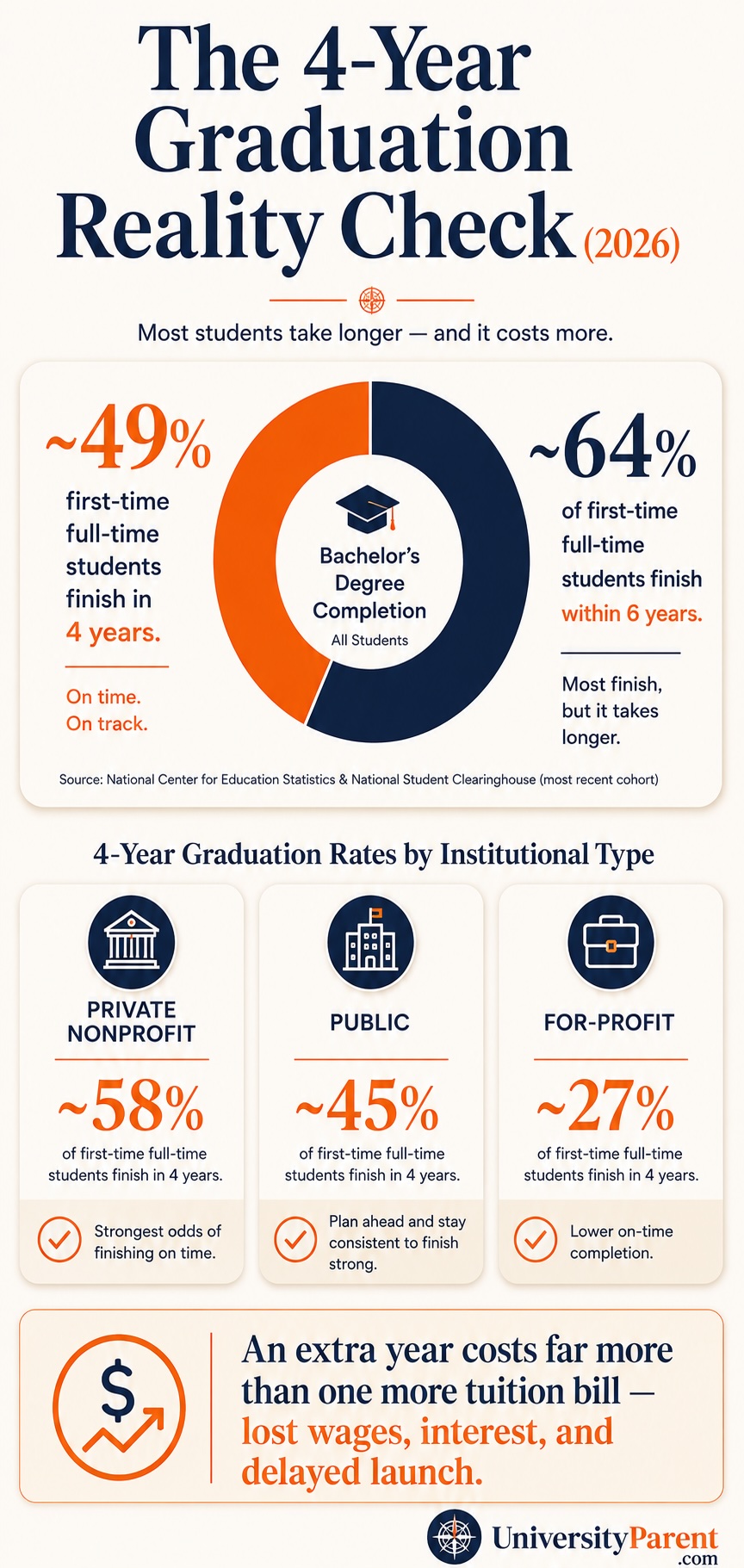
The phrase “four-year college” sets an expectation that the data does not support. Nationally, fewer than half of first-time, full-time students who start at a four-year school finish a bachelor’s degree in four years. The most recent federal figure is about 49 percent. The number most colleges and the federal government actually report is the six-year rate, which lands around 60 to 64 percent. A small number of colleges have now gone further and rebuilt the degree itself around fewer credits, which raises a separate set of questions for families weighing 90-credit bachelor’s degrees and the new three-year degree.
That is not a small gap. It means the “standard” success measure schools quote already assumes two extra years of college for a large share of students. Most parents never hear this until they are living it.
The four-year rate also varies enormously by the type of school, which is exactly why your student’s choice of campus matters more than its rank (National Center for Education Statistics, most recent cohort):
- Private nonprofit universities: about 58 percent graduate in four years (the most selective are far higher).
- Public universities: about 45 percent on the four-year timeline.
- For-profit institutions: about 27 percent in four years.
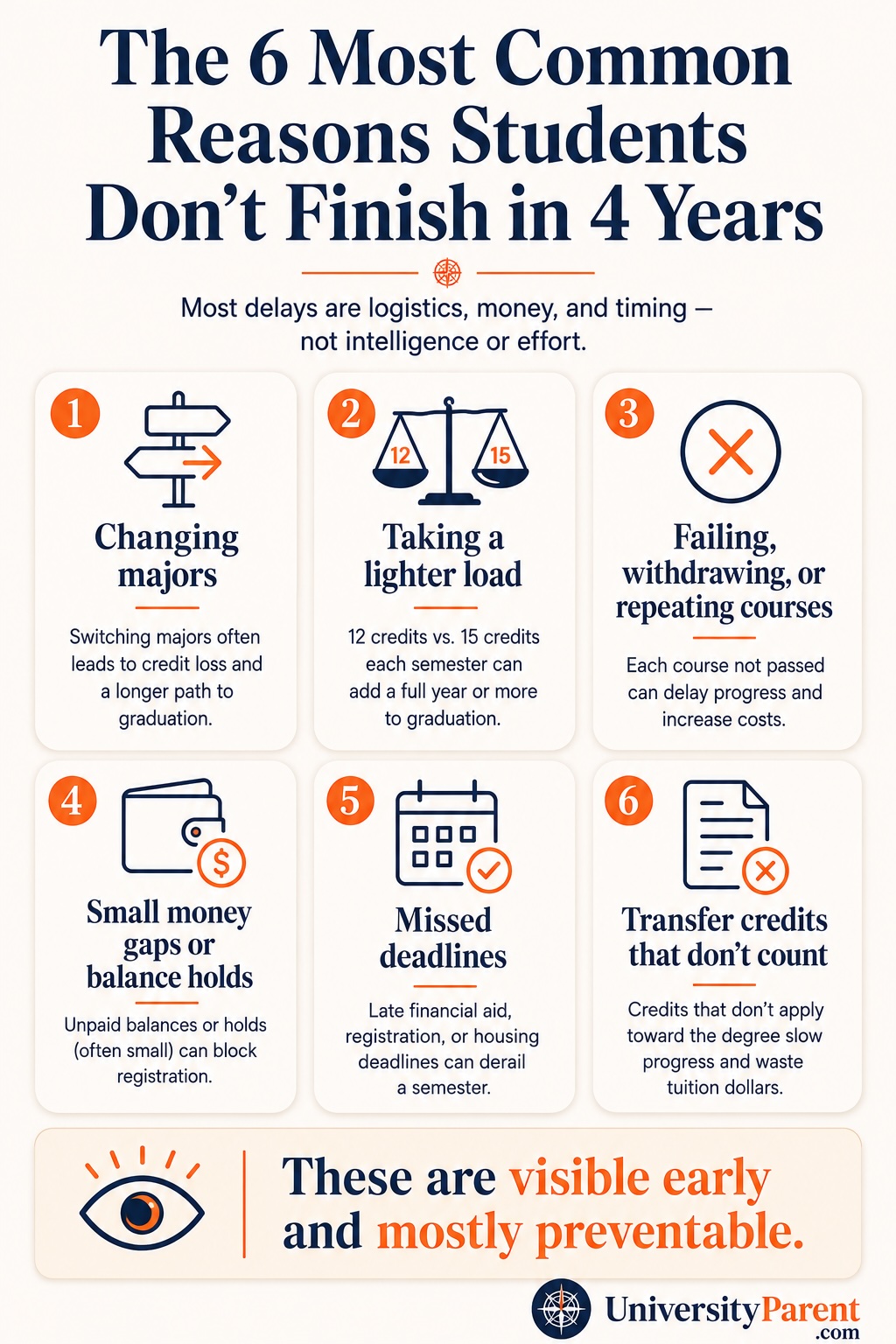
So why do so many strong students take longer? The reasons are remarkably consistent, and they are mostly not about intelligence or effort:
- Changing majors, which adds required courses and can strand earned credits.
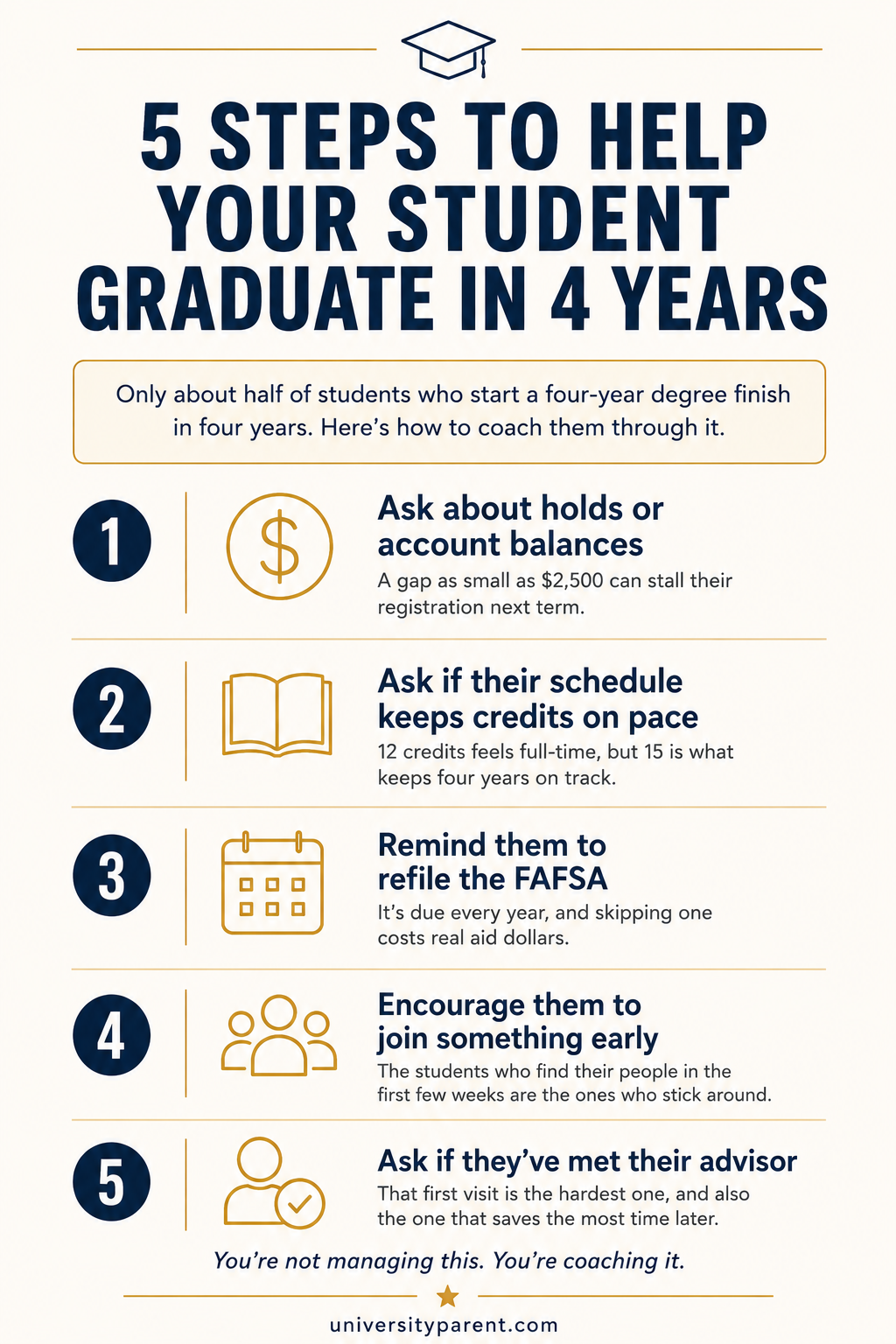
- Taking a lighter load (12 credits instead of 15) to manage cost or a job, which puts a student behind without anyone noticing.
- Failing, withdrawing from, or repeating a course.
- Losing financial aid eligibility or hitting a balance they cannot pay.
- Transfer credits that do not carry over.
- Missing a deadline (financial aid, registration, a form) that pushes a requirement to the next term.
Read that list again. Almost none of it is “my student could not handle college.” Most of it is logistics, money, and timing. That is the hopeful part, because logistics, money, and timing are things a family can see coming.
One email a week, for parents doing this right now
The deadlines, checklists, and conversation scripts that actually matter at each stage of the year. Free, and you can unsubscribe anytime.
Looking for the free toolkits? They are on our resources page, no email required.
Why an extra year is so expensive
When the diploma is the goal, an extra semester or year feels like a minor delay. Financially, it is one of the most expensive things that can happen to a family, and the cost is much larger than one more tuition bill.
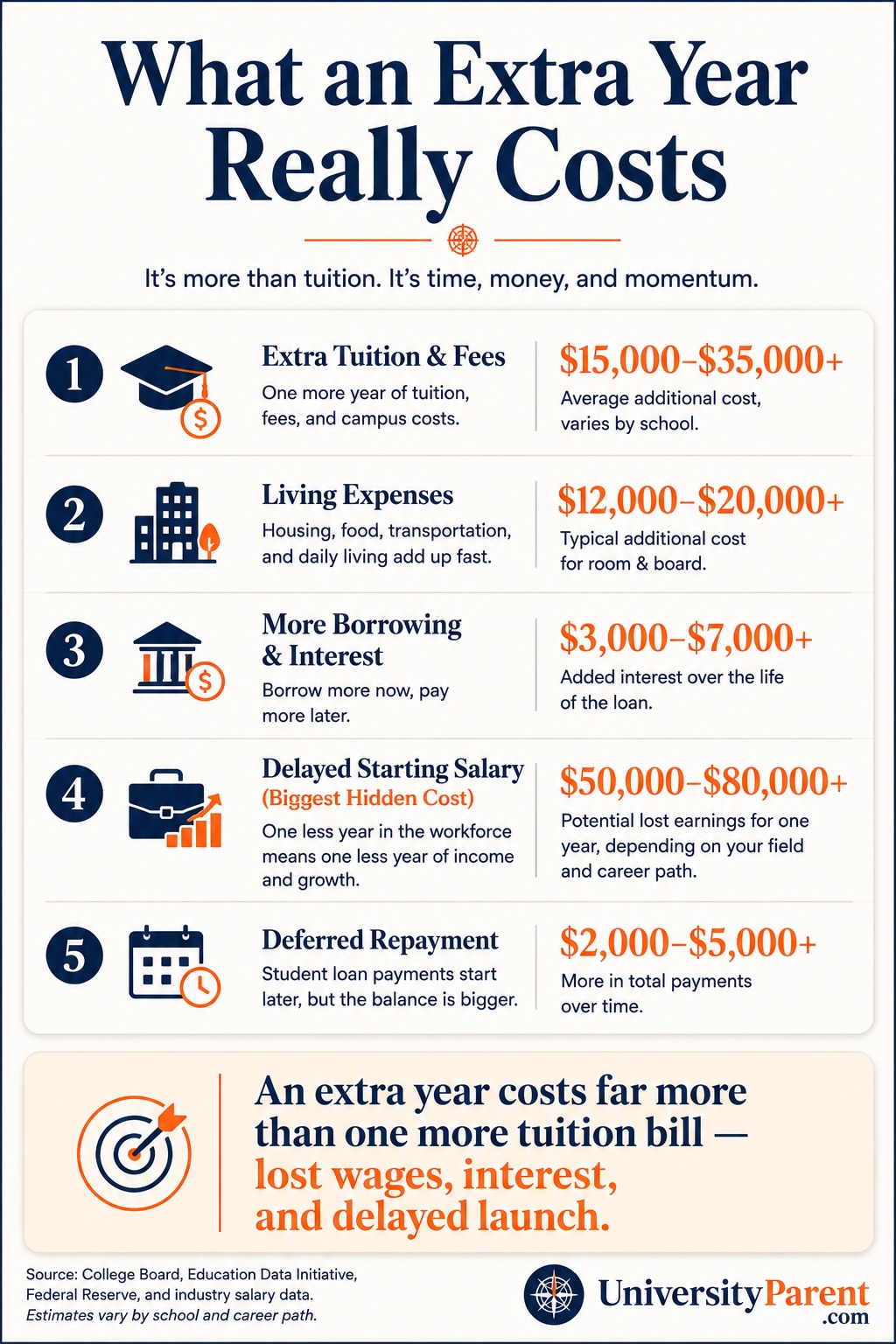
A fifth year (or even a fifth and sixth) adds up across several lines at once:
- More tuition and fees, often at a higher rate than the year the student started.
- Another year of living expenses: housing, food, transportation, and everything that comes with simply being in school instead of earning.
- More borrowing, which means more interest over the life of the loan.
- A delayed paycheck: every extra semester in school is a semester not earning a starting salary, which is the single biggest hidden cost.
- Deferred loan repayment that pushes the family’s whole financial timeline back.
For families paying out of pocket and for students taking loans, “on time” is not a bragging right. It is real money. This is the part of the college conversation most schools do not lead with, and it is exactly the part that belongs at the kitchen table before freshman year, not after.
The point of this guide
Helping a student thrive does not mean getting into the hardest school that will admit them. It means landing at a school where they will actually graduate, on a timeline they can afford, and walk into work that fits. Staying on track for four years, if that is the goal, is one of the most valuable things a family can plan for together. The good news: the signals are visible, and they show up early.
What one university learned about why students fall off track
If you want to understand what actually derails graduation, the most useful place to look is a university that decided to fix it and measured the results. Georgia State University (GSU) is that case study, and what it found is both surprising and reassuring.
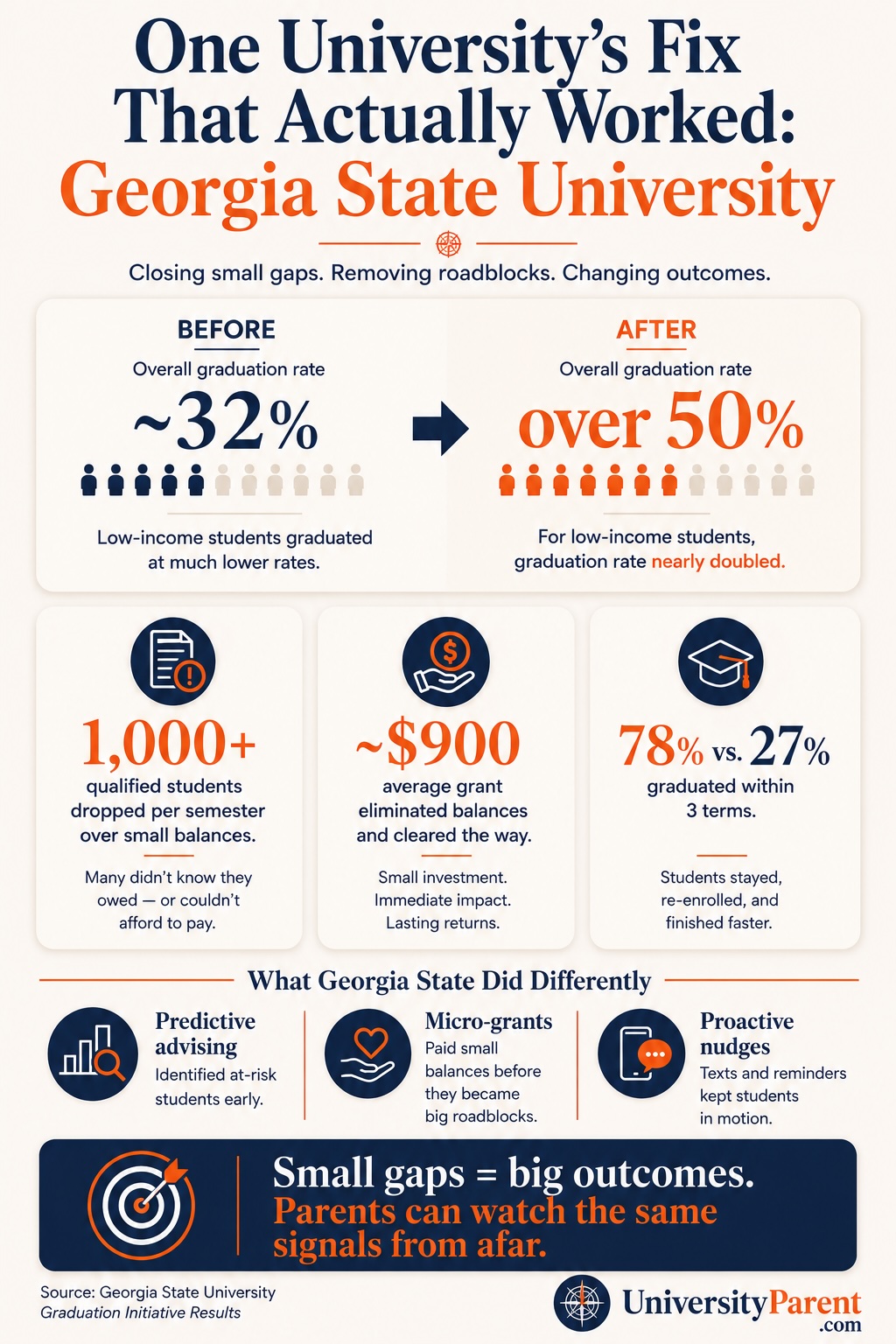
Starting in 2011, GSU discovered something that should change how every parent thinks about this. Each semester, more than 1,000 well-qualified students (students in good academic standing, many of them seniors) were being dropped from their classes. Not for grades. For unpaid balances, often under $2,500, after they had exhausted their financial aid. These were students close to the finish line, knocked out by a relatively small money gap.
GSU’s response, the Panther Retention Grant, was almost mundane: identify students with small balances who met basic eligibility, and give them a small completion grant (averaging around $900) to keep them enrolled, paired with a short financial literacy course. The results were not mundane at all.
In one analyzed year, about 78 percent of senior grant recipients graduated within three terms, compared with about 27 percent of a comparison group of Pell-eligible seniors who were dropped for non-payment. Recipients were more than twice as likely to finish. Since the program began, the large majority of recipients have gone on to graduate, and nine out of ten were still enrolled a year later. An independent Boston Consulting Group analysis found the program returned millions to the university because retained students are students who keep paying tuition and, more importantly, actually earn the degree they came for.
GSU did not stop at money. It built a system around the idea that most dropouts are predictable and preventable:
- Predictive advising. The university tracks hundreds of risk factors and sends advisors an automatic alert when a student drifts off the path to their degree, so support arrives before a small problem becomes a withdrawal.
- Proactive outreach. A text-message assistant nudges students about financial aid steps, registration, and deadlines, which cut “summer melt” (admitted students who never show up) and lifted on-time financial aid filing.
- Emergency micro-grants for exactly the small, sudden gaps that end an otherwise successful college run.
The outcome: GSU raised its overall graduation rate by more than 20 points (from about 32 percent to over 50 percent) and nearly doubled it for low-income students, closing the gaps between low-income, first-generation, minority students and everyone else. A multi-year Burning Glass Institute study of more than 40,000 GSU undergraduates found the same supports that helped students graduate also led to stronger earnings and career mobility years into the workforce. The National Institute for Student Success is now spreading these methods to more than 80 other institutions.
Here is the part that matters for your family. You cannot install GSU’s software at home. What you can do is watch the same handful of signals that GSU built an entire system to catch, and you can do it one student at a time, which is the one thing a university never can.
The six markers, and what you can do from afar
Translate GSU’s playbook into plain English and it becomes a short list of things that separate “on track for four years” from “this is going to take five or six.” Here is the honest catch: most of these you cannot see from home. You will not know whether your student is skipping class or sitting in the front row. So each marker below has two parts, the quiet signal to watch for, and the one thing you can actually do from a distance to help. The second part matters more, and it is the heart of moving from caretaker to coach. The goal is not to manage these problems for your student. It is to set them up to manage their own, then check in like a coach, not a supervisor.
One theme runs through all of it, and it is backed by decades of student-success research: the students who persist are the ones who ask for help early, and help-seeking is a learned skill, not a personality trait. Almost everything below is a way to make asking for help feel normal and expected rather than like an admission of failure.
1. Small money gaps, the silent dropout
The most important lesson from GSU: capable students do not usually leave because they failed. They leave because of a balance they cannot cover at exactly the wrong moment. A few hundred dollars at the term-bill deadline can end an otherwise successful college run.
2. The paperwork cliff (FAFSA, deadlines, summer melt)
Financial aid is not a one-time event. The FAFSA has to be refiled every single year, and a missed deadline can shrink or delete a package. The summer before freshman year and the renewal window each spring are the danger zones.
3. The credit math (15 is on track, 12 is behind)
This is the one most families get wrong, and it has two halves. The first half is the number. A bachelor’s degree is typically about 120 credits, so finishing in four years means averaging 15 credits a semester, or 30 a year. “Full-time” status often starts at just 12 credits, which adds up to 24 a year and quietly guarantees a fifth year. Taking 12 to “ease in” is a four-year plan turning into a five-year plan in real time.
The second half matters even more: those 15 credits have to be the right credits, taken in the right order. College courses build on each other through prerequisites (the class you must pass before you are allowed to take the next one), and many required upper-level courses are offered only once a year. Miss the sequence and a student can be enrolled full-time, on paper, while still slipping a full year behind, because the one course that unlocks the rest will not come around again until next fall. A student can take fifteen credits of the wrong classes and end up no closer to the degree. The fix is the degree map: most schools publish a recommended semester-by-semester plan and an online degree audit (often called Degree Works) that tracks exactly what is left, and a five-minute advisor check before each registration keeps the order intact. We walk through how to read a degree map, decode prerequisites, and use a degree audit in our guide to choosing the right classes in the right order.
4. Early academic signals
By the time a final grade lands, the semester is over. GSU’s whole system is built on catching trouble while it is still fixable, and you can do a lighter version from a distance. The honest limit: you will not know whether your student is going to class, and trying to monitor that from home backfires. What works is setting expectations before they leave and keeping a low-key, regular check-in once they are there. There is also a money angle worth naming out loud: most financial aid requires “satisfactory academic progress,” so slipping grades can put funding at risk, not just the GPA.
5. Whether they are using the support that already exists
GSU’s biggest lever was proactive advising. At most schools the advising, tutoring, writing center, and career office all exist and are already paid for, but students do not use them until something breaks. The students who graduate on time tend to meet their academic advisor every term and run a degree audit so there are no surprises in year four.
6. Belonging and well-being
A student who feels alone or is struggling emotionally is a student at risk of leaving, full stop. The first six weeks are the highest-stakes window for connection. Academic problems and mental health problems often travel together, and either one can stall a degree. We go deeper on both in our guides to how college students build belonging and college student mental health.
You do not need to monitor all six at once. Pick the two or three conversations that fit your student and have them on a calendar, not in a panic. A five-minute check on the term bill, the credit count, and the advisor meeting, done every semester, catches almost everything on this list before it costs a year.
Two choices that can add a year (and when that is fine)
Not every reason a degree runs long is a problem to prevent. Two of the most common are real, valuable choices, and the point is not to avoid them. It is to make them on purpose, with eyes open, so a four-year plan does not stretch by accident.
The undecided major
Starting undecided is completely normal and often wise. Rushing into the wrong major and switching out later tends to cost more than taking a beat to choose. The risk is not being undecided, it is drifting. A student who spends the first three or four semesters knocking out general-education requirements and genuinely sampling fields stays on track, because those credits count no matter what they eventually declare. A student who floats with no plan, collects scattered electives, and declares late can run out of room to climb a long prerequisite chain (this is exactly what the credit-sequencing guide helps prevent). The rule of thumb: undecided is fine, undirected is not. Most students should settle on a major by the end of sophomore year to keep four years realistic, and sooner in fields with long prerequisite chains like engineering, nursing, or the sciences.
Study abroad and other detours
Study abroad, a co-op, an internship semester, or adding a second major can be among the best parts of college, and any of them can also add a term or two. That can be a perfectly good trade. The mistake is being surprised by it. The fix is simple: before committing, your student sits down with their advisor and confirms exactly how the experience maps onto the degree, which credits transfer back, and which specific requirements they satisfy, not just whether they count as electives. Planned a year ahead, a semester abroad often fits inside four years. Decided on impulse junior year, it is frequently the thing that adds a fifth.
AP, IB, and dual-enrollment credits buy slack
Credits a student brings from high school (AP, IB, or dual enrollment) are the quiet advantage that makes all of this easier. They can clear general-education requirements and even some prerequisites, which buys room to change a major, study abroad, or carry a lighter term without losing the timeline. The earlier caution still applies: confirm with the registrar exactly how each credit applies, because one that counts only as a general elective pads the total without clearing a requirement. Used well, incoming credits are the cushion that lets a student make one of these choices and still finish on time.
The through-line
An extra year is not a failure. Sometimes it is a co-op that lands the first job, or a semester abroad that changes a life. The only version worth preventing is the accidental one: the year added by a missed prerequisite or a choice no one planned for. Know the trade, make it on purpose, and build it into both the plan and the budget together.
The on-track-for-four-years check-in
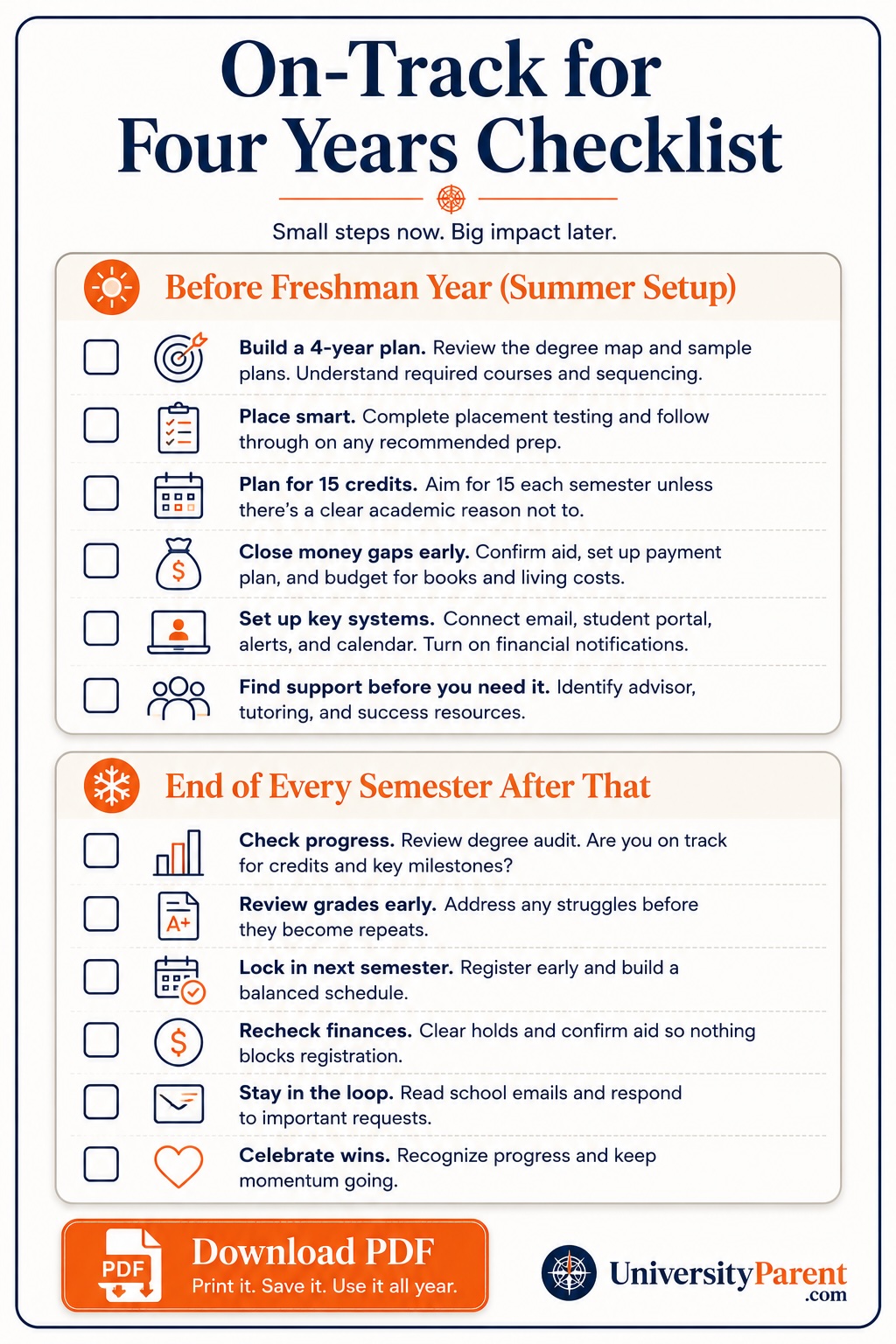
This is the companion checklist for this guide. Use the first section once, the summer before freshman year, and the second section at the end of every semester after that. None of it requires logging into your student’s accounts. It is a set of conversations and confirmations.
Before freshman year (the summer setup)
Do these once, before move-in, so the foundation is solid.
Money and aid
- FAFSA filed, and we know what to refile next year and when.
- We know the exact term-bill due date and what is and is not covered by aid.
- We have a small buffer or a plan for a surprise gap of a few hundred dollars.
- We asked whether the school has emergency or completion grants, and how to reach them.
The four-year math
- We know how many total credits this degree requires.
- First-semester schedule is 15 credits (or we have a deliberate plan if it is not).
- We know who the academic advisor is and that a first meeting is on the calendar.
Connection
- Our student has one plan to meet people in the first two weeks (a club, a job, an activity).
- We both know where the campus health and counseling center is.
End of every semester after that
A ten-minute check, four to eight times across the degree. This is the whole system.
Stay on the timeline
- Credits this term landed at or above 15, or we have a clear plan to catch up.
- No dropped, failed, or repeated course this term (or we have a plan for it).
- Next semester is registered, and the schedule was checked against degree requirements.
- Our student met with their advisor and knows they are on track to graduate on time.
Protect the money
- Next term’s bill is covered, with no surprise balance or hold.
- FAFSA is refiled for next year (or on the calendar).
- Grades are high enough to keep financial aid and any scholarships.
Check the human
- Our student has people and a sense of belonging, not just classes.
- Stress feels normal, not constant, and they know how to get help if it tips over.
Get the printable checklist
The summer-setup and every-semester checklist as a one-page printable PDF. Enter your email and we will take you straight to the download.
The reframe: the right school beats the ranked school
Everything above leads to one idea that sits at the center of how we think about college here. The goal is not the most prestigious acceptance letter. The goal is a degree your student actually finishes, on a timeline you can afford, that opens a door to meaningful work.
That changes how you read a college list. A school’s graduation rate is not a vanity statistic. It is a prediction about your own student’s odds, and it is public. Before you fall in love with a name, look up the four-year and six-year graduation rates for each school on the list using the free NCES College Navigator. A school where most students finish in four years is telling you something real about its advising, its support, and its culture. A school where the four-year rate is low is telling you something too.
Fit, affordability, and the odds of finishing are not the boring part of the college search. They are the part that determines whether the whole investment pays off. A student who graduates in four years from a good-fit school they could afford is, in almost every way that matters, better launched than a student who took six expensive years to finish somewhere more famous.
See how the schools on your list compare
We pulled the four-year and six-year graduation rates and first-year retention for 268 colleges into one place, each shown against the national average, so you can see at a glance where a school stands.
Free tools to plan ahead
Before the acceptances come in, it helps to see the real numbers side by side.
- College Cost Comparison Calculator: compare the true four-year cost (and the gap you would need to cover) across schools.
- SAI Estimator: estimate your federal aid index before you file.
- College Match Tool: find good-fit schools, not just famous ones.
Pair these with our guides to paying for college, the most common FAFSA mistakes, and the new Parent PLUS loan caps.
Major indecision is a timeline risk. Changing majors late is one of the most common ways a fourth year gets added. Our guide to helping your student choose a major covers the conversations that keep the clock on schedule.
Questions parents ask
What percentage of students actually graduate in four years?
Nationally, fewer than half of first-time, full-time students at four-year schools finish a bachelor’s degree in four years, roughly four in ten to just under half. The rate climbs to about 60 to 64 percent when measured over six years, which is the timeline most colleges and the federal government report.
Why do so many students take five or six years?
The most common reasons are not academic ability. They are changing majors, taking fewer than 15 credits a semester, failing or withdrawing from courses, losing transfer credits, and money or deadline problems that push requirements into a later term. Most of these are visible early and preventable.
How many credits does my student need to graduate in four years?
A bachelor’s degree is typically about 120 credits, so an on-time pace is roughly 15 credits per semester, or 30 a year. Many students assume “full-time” (often 12 credits) is enough, but 12 credits a semester adds up to a fifth year.
What is the biggest thing parents miss?
Small money gaps. The Georgia State University data showed that more than a thousand qualified students were dropped each semester over balances often under $2,500. A small, well-timed grant more than doubled their odds of graduating. Knowing the term-bill deadline and keeping a small buffer protects against the most preventable cause of dropping out.
Is a school’s graduation rate worth paying attention to?
Yes. It is a public, school-specific prediction of your student’s odds of finishing. Look up four-year and six-year rates on the NCES College Navigator for every school on the list. A higher rate usually reflects stronger advising, support, and culture, which directly affects whether your student graduates on time.
Does being undecided about a major delay graduation?
Not by itself. A student who stays undecided but spends the first few semesters completing general-education requirements and exploring fields stays on track, because those credits count toward any degree. Delay tends to come from drifting without a plan, or from declaring a major with long prerequisite chains too late. Aim to choose by the end of sophomore year, sooner for fields like engineering or nursing.
Does studying abroad delay graduation?
It can, but it does not have to. The deciding factor is planning. If your student confirms with their advisor ahead of time how the courses abroad satisfy specific degree requirements, not just elective credit, a semester abroad often fits within four years. Decided late, it is a common reason a degree stretches to a fifth year, which can be a worthwhile trade when it is intentional and budgeted for.
Can AP or IB credits help my student graduate on time, or even early?
Often, yes. Credits from AP, IB, or dual enrollment can clear general-education requirements and sometimes prerequisites, creating room to change majors, study abroad, or take a lighter term without falling behind. Some students use them to finish a semester early. Confirm with the registrar exactly how each credit applies, because some count only as general electives and do not satisfy a specific requirement.
How can I help from far away without hovering?
Stay in the coaching seat. Set expectations before move-in, keep the recurring deadlines and the once-a-semester questions (term bill, credit count, advisor meeting) on the calendar, and ask about the experience rather than the grade. Point your student to the resources and let them make the call or the appointment. The goal is to make asking for help feel normal, not to manage the problem for them.
Is it bad if my student takes five years to graduate?
Not necessarily. A fifth year sometimes reflects a co-op, a double major, or a study-abroad term that adds real value. What is worth avoiding is the accidental extra year caused by a missed prerequisite, a late major change, or an unplanned withdrawal, because that version mostly adds cost without adding opportunity. Aim for an on-time degree if that is the goal, and a deliberate choice if it is not.
Sources:
National Institute for Student Success, ROI Study of the Panther Retention Grants (Boston Consulting Group). ·
Georgia State University, Panther Retention Grants. ·
Ithaka S+R, The Impacts of Emergency Micro-Grants on Student Success (debt-reduction figure). ·
EAB, Georgia State data-driven interventions. ·
Mainstay, GSU behavioral intelligence case study. ·
NCES Fast Facts and Digest table 326.10, graduation rates. ·
National Student Clearinghouse, Completing College. ·
NCES College Navigator.