

Best Mini Fridge for a Dorm Room (2026)
Dorm and Packing
For most dorm rooms, the right mini fridge is somewhere between 3.0 and 3.3 cubic feet. That is enough for a week of drinks, snacks, and leftovers, short enough to sit under a lofted bed, and inside the size cap at the large majority of schools that set one. Before you buy anything, confirm two things with the housing office: whether there is a cubic foot limit, and whether the room already comes with a fridge. Of the 101 universities in our appliance policy dataset, 12 supply a refrigerator in the room and the University of South Carolina prohibits personal standalone units outright, so a fridge bought in July can be a fridge driven home in August.
After that, three things separate a fridge your student keeps for four years from one they resent by October: a reversible door, ENERGY STAR certification, and whether they need a true freezer or only a chiller compartment. Below are picks by use case, with the specification that justifies each one.
Best Dorm Mini Fridges at a Glance
| Pick | Best for | Capacity | Freezer | ENERGY STAR |
|---|---|---|---|---|
| Frigidaire EFR331 | Best overall | 3.2 cu ft | Chiller compartment with ice tray | Yes, 197 kWh/yr |
| Midea WHD-113FSL | Best true separate freezer | 3.1 cu ft (2.2 fridge, 0.9 freezer) | Yes, full width with its own door | Yes, 270 kWh/yr |
| Upstreman CR32 | Most usable fridge space | 3.2 cu ft | None, all fridge | Yes, 258 kWh/yr |
| Midea WHS-65LB1 | Tight rooms, quietest published rating | 1.6 cu ft | Freezer compartment plus chiller box | Yes, 207 kWh/yr |
Check Your School’s Policy First
Spend five minutes with the housing handbook before anything goes in the cart. Schools vary more than parents expect, and a fridge that gets turned away at move-in or docked at checkout is an avoidable expense.
The most common restriction is a size cap, usually stated in cubic feet. Some halls also limit total wattage or amperage per room. And a meaningful number of schools either supply a unit or run a rental program through the housing office, which means buying one was never necessary.
From our research: across the 101 universities in our appliance policy dataset, 84 allow a personal mini fridge, 12 supply one in the room, 1 prohibits personal standalone units, and 4 vary by building. Brown University supplies a unit and states that personal fridges will be confiscated. See where your school falls in the 101-university appliance rules study.
Every full size pick below is 3.3 cubic feet or under. For the school by school picture of what is permitted, our companion guide covers the policy side in detail: are mini fridges allowed in dorms, and the rules at 22 schools. That page owns the question of what your school allows. This page covers which model to buy once you know.
What Size Mini Fridge Fits a Dorm Room
Capacity in a compact fridge is measured as total interior volume, which includes any freezer or chiller section. A 3.1 cubic foot model with a 0.9 cubic foot freezer gives you only 2.2 cubic feet of actual refrigerator space, so two fridges with the same headline number can hold very different amounts of food.
Height matters as much as volume, because the usual plan is to slide the fridge under a lofted bed or next to a desk. The picks below run from 19.4 inches tall (Midea 1.6) to 33.9 inches (Midea 3.3). Measure the space before ordering rather than assuming a compact fridge will fit under a bed at its lowest setting.
A chiller compartment is a small insulated box inside the fridge cabinet. It will hold ice cubes and keep things very cold, but it is not a freezer and will not reliably keep ice cream or frozen meals frozen. A true freezer has its own door and its own temperature range. Only one pick on this page, the Midea WHD-113FSL, has the second kind.
What Actually Matters When Comparing Models
| Feature | What to look for | Why it matters in a dorm |
|---|---|---|
| Size | 3.0 to 3.3 cu ft for a standard room. Under 2 cu ft only if floor space is genuinely scarce. | Below about 1.7 cu ft you can hold drinks and little else. Above 4.5 cu ft many schools will not allow it and it dominates the floor. |
| Reversible door | A hinge that can be moved to either side. All four full size picks here have one. | Dorm layouts are fixed and often awkward. A door that only opens one way can end up blocked by a bed frame or desk. |
| ENERGY STAR certification | Check the federal certified product database rather than the listing copy. | Certified compacts in this size range draw roughly 197 to 270 kWh per year. Temple University requires ENERGY STAR certification outright. |
| Freezer versus chiller | A true freezer has its own outer door. A chiller compartment sits inside the fridge cabinet. | If your student wants frozen meals or ice cream, a chiller will disappoint them. If they mainly want cold drinks, a chiller is fine and buys back shelf space. |
| Defrost type | Automatic defrost if you can get it. Manual defrost is still common at this size. | Students do not defrost freezers. A manual defrost compartment will ice over by spring if the thermostat is left high. |
| Noise | Compare published dBA ratings on manufacturer spec sheets, not review anecdotes. | A compressor cycling at 2 a.m. in a shared room causes real friction. Not every manufacturer publishes a rating. Among these picks only the Midea WHS-65LB1 does, at 36 dB. |
| Door storage | A 2 liter bottle rack and a can dispenser or can rack. | Door storage is close to free capacity. A model with one shallow shelf wastes a third of its usable volume. |
Decibel figures in this guide come from manufacturer specification sheets and are measured under test conditions, not in a dorm room with the fridge pushed against a wall. Treat them as a way to compare models against each other rather than as a promise about how the unit will sound at 2 a.m.
The Picks, by Use Case
These are ordered by how most families will use them, not by price. Prices on compact refrigerators move constantly, so each card links to the current Amazon listing rather than quoting a figure that will be wrong in a week.

Frigidaire EFR331 3.2 Cu. Ft. Compact Refrigerator
The most efficient model in this lineup and the easiest to recommend without caveats. It is ENERGY STAR certified at 197 kWh per year, the lowest annual consumption of any pick here, which also clears the certification requirement at schools like Temple that mandate it. Frigidaire lists two glass shelves, a 2 liter door basket, a built in can dispenser, and a chiller compartment with an ice cube tray. The door is reversible, and at 30 inches tall it is the shortest of the full size picks, which gives you the most room to work with under a lofted bed. Worth knowing before you buy: the cold section is a chiller, not a true freezer, and the defrost is manual.
- 3.2 cu ft
- ENERGY STAR 197 kWh/yr
- Chiller, not a freezer
- Reversible door
- Manual defrost
- 30 in tall

Midea WHD-113FSL 3.1 Cu. Ft. Double Door Mini Fridge
The only pick here with a real freezer rather than a chiller box. Midea splits the 3.1 cubic feet into 2.2 for the refrigerator and 0.9 for a full width freezer with its own outer door, so frozen meals and ice cream actually stay frozen. It is ENERGY STAR certified at 270 kWh per year, with automatic defrost, a reversible door and two removable glass shelves. The trade off is real: you give up roughly a third of the refrigerator space to get the freezer, and it is the most expensive pick on this page. Choose it only if the freezer is genuinely the point.
- 3.1 cu ft total
- 0.9 cu ft true freezer
- ENERGY STAR 270 kWh/yr
- Reversible door
- Automatic defrost
- 33 in tall
Upstreman CR32 3.2 Cu. Ft. All Refrigerator
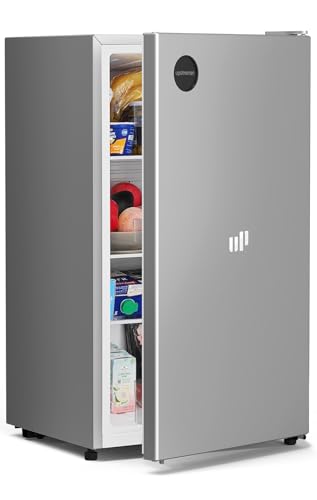
This one is all fridge space, and that is the reason to buy it. There is no freezer and no chiller box, so the entire 3.2 cubic feet is refrigerator, which makes it the roomiest cold storage on this page for drinks, leftovers, and anything that needs to stay cold but not frozen. It is ENERGY STAR certified at 258 kWh per year with automatic defrost, which matters because nobody in a dorm defrosts anything. Upstreman lists three adjustable glass shelves, three door bins, an LED interior light, a reversible door, and a thermostat range of 32 to 50 degrees Fahrenheit. At 32.8 inches and 44 pounds it is one of the two tallest picks here, so measure your space before assuming it slides under a lofted bed.
- 3.2 cu ft, all fridge
- No freezer
- ENERGY STAR 258 kWh/yr
- Automatic defrost
- Reversible door
- 32.8 in tall

Midea WHS-65LB1 1.6 Cu. Ft. Mini Fridge
At 19.4 inches tall this fits on top of a dresser or under a desk where nothing else on this page will go, which makes it the practical answer for a triple, a converted double, or a student sharing a roommate’s main fridge. Midea publishes a 36 dB rating for it, the only published noise figure among these picks, so it is also the one to look at first if your student is a light sleeper. ENERGY STAR certified at 207 kWh per year, with a reversible door, a freezer compartment, a chiller box, and a 2 liter bottle rack. The honest limit is capacity: 1.6 cubic feet with one shelf holds drinks, condiments, and a few days of snacks, not a week of groceries.
- 1.6 cu ft
- ENERGY STAR 207 kWh/yr
- 36 dB published
- Freezer compartment
- Reversible door
- 19.4 in tall
Buying Versus Renting
Plenty of campuses run a fridge rental program through the housing office or an outside vendor. Rentals deliver before move-in, collect after move-out, and cover maintenance, which removes the two genuinely annoying parts of dorm fridge ownership: hauling it in May and storing it over the summer.
The math is straightforward. Get the rental quote for the full academic year and compare it against the purchase price of a comparable fridge. If your student expects to live on campus for more than one year, buying usually wins, because the same unit carries over. If freshman year is the only certainty, or if the room is a walk-up, renting is often worth the premium. Either way, ask before you buy, because a school that supplies a fridge makes the whole question moot.
One email a week, for parents doing this right now
The deadlines, checklists, and conversation scripts that actually matter at each stage of the year. Free, and you can unsubscribe anytime.
Looking for the free toolkits? They are on our resources page, no email required.
FAQ
What size mini fridge should I get for a dorm room?
Between 3.0 and 3.3 cubic feet suits most dorm rooms. That holds a week of drinks, snacks, and leftovers while staying inside the size cap at the large majority of schools that set one. Drop to around 1.6 cubic feet only if floor space is genuinely scarce or your student is sharing a roommate’s fridge. Remember that the headline capacity includes any freezer section, so a 3.1 cubic foot model with a 0.9 cubic foot freezer leaves only 2.2 cubic feet of refrigerator space. Always confirm your school’s specific limit before buying.
Do dorm rooms allow mini fridges?
Usually, but not always. Across the 101 universities in our appliance policy dataset, 84 allow a personal mini fridge, 12 supply one in the room, 1 prohibits personal standalone units, and 4 vary by building. Brown University supplies a unit and states that personal fridges will be confiscated. Schools that allow them often still set a cubic foot cap or a wattage limit, so check the housing handbook or email the housing office before ordering.
What is the difference between a chiller compartment and a real freezer?
A chiller compartment is a small insulated box inside the refrigerator cabinet. It will make ice cubes and keep items very cold, but it does not hold a separate freezing temperature, so ice cream and frozen meals will not reliably stay frozen. A true freezer has its own outer door and its own temperature range. Most compact fridges in the dorm size range have only a chiller. Among the picks on this page, only the Midea WHD-113FSL has a true separate freezer, at 0.9 cubic feet.
How quiet is a dorm mini fridge?
Manufacturers do not all publish a noise rating. Among the models on this page the Midea WHS-65LB1 is the only one that does, at 36 dB. That figure comes from a manufacturer specification sheet and is measured under test conditions, so treat them as a way to compare models rather than a promise about how a unit will sound in a specific room. Placement matters too: a fridge pushed tight against a wall or into a corner reflects more compressor noise into the room than one with clearance behind it.
Should I buy or rent a dorm mini fridge?
Compare the full academic year rental quote against the purchase price of a comparable fridge. Renting through the housing office removes the two worst parts of ownership, hauling the fridge at move-out and storing it over the summer, so it often makes sense when freshman year is the only certainty. Buying usually wins if your student expects to live on campus more than one year, since the same unit carries over. Ask first either way, because 12 of the 101 schools in our dataset supply a fridge and make the question moot.
Can my student and their roommate share one mini fridge?
Yes, and it is common. A 3.0 to 3.3 cubic foot fridge works for two students who are storing drinks, condiments, and snacks rather than doing real meal prep. A workable split is one full shelf plus half the door storage each. If both students plan to keep a meaningful amount of food, look at an all fridge model like the Upstreman CR32, which gives up the freezer to free the whole cabinet for refrigerated storage, or accept that two smaller units will serve them better.
The fridge is sorted. The first semester is not.
Dorm shopping is the part of freshman year that comes with a list. The College Parent Guide: Freshman Year (2026) is the handbook for the part that does not: homesick calls, the first bad grade, roommate conflict, and knowing which ones actually need you.
What to Sort Out Next
The fridge is one line on a much longer list. A few things worth handling in the same sitting:
- Confirm the rest of the appliance rules for your student’s hall. Microwaves are the most restricted item after hot plates: our dorm microwave rules guide covers where a personal unit is allowed and where the school supplies one.
- Work out what the fridge will actually hold. Our easy dorm meals with no kitchen guide is the practical version of that question.
- Build the full list. The complete dorm packing list covers everything room by room, and the move-in day checklist covers the day itself.
- Set the budget. Our dorm room budget breakdown shows where the money actually goes.
Get a Packing List Built for Your Student’s School
Our free Dorm Packing List Generator builds a customized checklist for your student’s specific school, dorm type, and climate, and it filters out appliances their campus does not allow.
Whichever tier fits your budget, the sequence is the same: confirm the housing policy, decide whether you need a true freezer or just a chiller, then buy the most efficient model that fits the space. Get those three right and the fridge is the last thing anyone thinks about all year.
UniversityParent Team