

Best Single-Serve Coffee Makers for Dorms (2026): Keurig, Nespresso, and What’s Actually Allowed
Of all the appliances parents debate before move-in day, a single-serve coffee maker is usually the easiest yes. Keurigs, Nespresso machines, and similar pod-based brewers are permitted at the vast majority of colleges, often even at schools that ban microwaves, kettles, and anything else that generates heat. Housing staff tend to see them as contained, purpose-specific appliances rather than open-ended cooking devices.
That said, there are real exceptions (UCLA and UCSB ban coffee makers outright, and BYU prohibits them for Honor Code reasons), and there are enough variation in model sizes and power draws to make the buying decision worth thinking through. This guide covers who needs to check their policy, what to look for in a dorm-safe model, and the compact options that work best in a 12×12 room.
Jump to section
Disclosure: This post contains affiliate links. If you purchase through our links, we may earn a small commission at no extra cost to you. We only recommend products we’d actually suggest to our own kids’ parents.
Are Coffee Makers Allowed in Dorms?
For most schools: yes, with no additional conditions beyond the standard “UL-certified, no open heating elements” language that covers all small appliances. Single-serve pod brewers are widely accepted because they’re self-contained (water goes in, coffee comes out, the machine shuts off automatically), compact, and low-risk compared to appliances that could be left running.
There are three categories of exceptions worth knowing about before you buy:
Schools with a full heating appliance ban. A small number of schools, primarily dense urban campuses with older electrical systems, ban all personal heating appliances in rooms, and coffee makers fall under that umbrella. UCLA and UC Santa Barbara are the most prominent examples. At these schools, even a Keurig K-Mini isn’t permitted in a standard dorm room. Common-area coffee makers in lounges are usually available as an alternative.
Schools with Honor Code restrictions. BYU prohibits coffee and tea by its Honor Code, which means coffee makers, regardless of type, aren’t appropriate to bring. An electric kettle for herbal tea is fine at BYU; a coffee maker is not.
Schools where the policy is vague. Some schools list “no cooking appliances” without specifying whether a single-serve coffee maker qualifies. In practice, these are almost always permitted, housing staff don’t typically confiscate Keurigs during inspections at schools that haven’t specifically banned them. But if you want certainty, a quick email to residential life asking about “single-serve pod coffee makers with automatic shut-off” will get you a definitive answer.
If your school isn’t in the exceptions above, you’re almost certainly fine. Check your housing handbook under “permitted appliances” or “prohibited items” to confirm, then buy with confidence.
One email a week, for parents doing this right now
The deadlines, checklists, and conversation scripts that actually matter at each stage of the year. Free, and you can unsubscribe anytime.
Looking for the free toolkits? They are on our resources page, no email required.
Why Keurigs Get a Pass When Kettles Don’t
This surprises a lot of parents: schools that ban electric kettles often explicitly allow single-serve coffee makers. The reasoning makes sense when you understand what housing staff are actually worried about.
An electric kettle is a general-purpose heating device. It boils water that can then be used for anything, cooking ramen, making soup, heating canned food. That open-ended utility puts it closer to a hot plate in the minds of housing staff. It also has a larger heating element and typically draws more current for a longer period during a full boil cycle.
A single-serve coffee maker is purpose-specific. Water goes in, passes through a heating element briefly, and coffee comes out. The total heated water volume per cycle is small (6-12 oz), the machine shuts off automatically when brewing is done, and there’s no scenario where you’d use it to heat a full pan of soup. It reads as an appliance, not a cooking tool.
Tufts University is a good concrete example: their housing policy explicitly bans electric kettles but carves out an exception for single-serve coffee makers. That distinction is common enough to be worth knowing when you’re deciding what to pack.
What to Look For in a Dorm-Safe Model
Size is the primary constraint
Dorm desks run 18-24 inches deep and are already occupied by a laptop, monitor, textbooks, and desk lamp. A coffee maker needs to fit in what’s left. The Keurig K-Mini is the benchmark here at 5 inches wide, genuinely narrow enough to tuck between other items. Full-size pod brewers (K-Duo, K-Elite) are significantly larger and impractical for most dorm setups. Stick to the compact “mini” tier.
Reservoir: removable vs. fixed
Compact Keurigs typically come in two designs: a fixed reservoir you fill cup-by-cup, or a removable reservoir you fill and refrigerate. For a dorm room, the removable reservoir (K-Mini Mate Plus) is meaningfully more convenient, you can fill it the night before or keep it in the mini-fridge so you don’t have to run to the bathroom every morning. It’s worth the extra $20.
Pod compatibility
All Keurigs accept K-Cup pods, which are available at every grocery store and in bulk on Amazon. Nespresso machines use either Original or Vertuo pods depending on the model, both are widely available but slightly more expensive per cup than K-Cups. If your student is cost-conscious, a Keurig with a reusable K-Cup filter ($10) lets them brew regular ground coffee at a fraction of the per-cup cost of pods.
Wattage and power draw
Single-serve coffee makers draw 1200-1500W during the brief heating cycle, similar to an electric kettle, but for a much shorter burst. This is well within what dorm circuits can handle, especially since the machine shuts off immediately after brewing. No special precautions beyond plugging into a wall outlet rather than a power strip shared with a mini-fridge.
Auto shut-off
All current Keurig models have auto shut-off after 90 seconds to a few minutes of inactivity. This is standard on every model we recommend. If you’re looking at an off-brand or older model, verify it has this feature, it’s the primary thing housing staff check for during inspections.
School-by-School Quick Reference
Policies as of 2026. Always verify with your school’s housing office before purchasing.
| School | Coffee Maker Policy | Notes |
|---|---|---|
| UCLA | Banned | All personal coffee makers banned in rooms. Lounges have common-area machines. |
| UC Santa Barbara | Banned | No personal cooking or heating equipment in rooms, including coffee makers. |
| BYU | Prohibited (Honor Code) | Coffee prohibited by Honor Code, coffee makers not appropriate to bring regardless of appliance policy. Electric kettles for herbal tea are fine. |
| Northwestern University | Varies | Single-serve makers may be permitted where kettles are not. Confirm with residential life, policy differs from general heating appliance ban. |
| Tufts University | Allowed | Single-serve coffee makers specifically exempted from the heating appliance ban. One of few schools to make this distinction explicit in writing. |
| Georgetown University | Allowed | Microwaves are banned but single-serve coffee makers are generally permitted. Verify current year’s handbook. |
| George Washington University | Allowed | Microwaves banned, but single-serve coffee makers typically permitted. |
| UConn | Allowed | Kettles are banned but single-serve coffee makers are permitted in rooms. |
| Yale University | Allowed | Kettles are not on the permitted list but single-serve coffee makers are generally allowed. Verify your specific college’s policy. |
| Most large state universities | Allowed | Single-serve coffee makers are permitted at nearly all large state schools with no special restrictions beyond UL certification. |
| Most private colleges | Allowed | Even schools with stricter general appliance policies tend to allow single-serve makers specifically. Verify if your school has a full heating appliance ban. |
Use our Packing List Generator to check the coffee maker policy alongside all other appliance rules for your student’s school in one place.
Our Top Picks for 2026
All four models below are compact, auto shut-off, and widely permitted at schools that allow single-serve coffee makers. We’ve covered the full range from bare-bones to premium.

Keurig K-Mini Single Serve Coffee Maker
The standard recommendation for dorm rooms, and for good reason. Just 5 inches wide, the narrowest Keurig made, so it fits on a crowded desk without dominating it. Brews any K-Cup in about 2 minutes, auto shut-off after 90 seconds. Fixed reservoir means filling cup-by-cup, which is fine for one person. No frills, no app, no subscription required. Around $80-$90. Available in a dozen colors if that matters to your student.
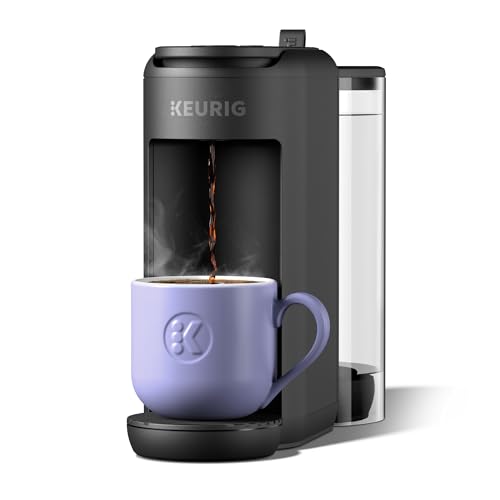
Keurig K-Mini Mate Plus Single Serve Coffee Maker
Same narrow 5-inch footprint as the K-Mini with one meaningful upgrade: a removable 12 oz reservoir you can fill in advance and store in the mini-fridge. For a student who makes coffee every morning before class, this eliminates the fill-and-brew friction of the base model. Also has a travel mug-friendly brew setting. About $100-$110, worth the extra $20 if coffee is a daily habit. This is the one we’d actually buy for a college student.
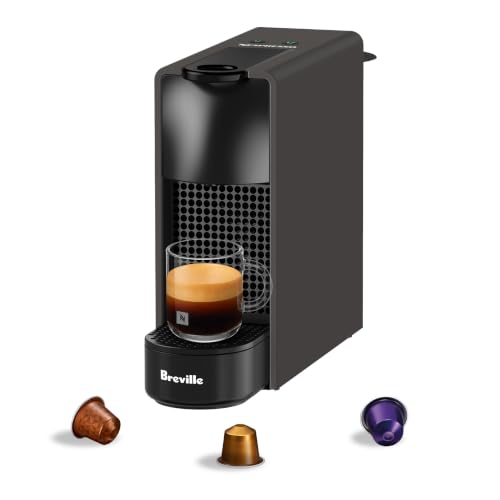
Nespresso Essenza Mini
For students who want real espresso rather than drip coffee. Compact at 3.2 inches wide, even narrower than the K-Mini, and produces genuine espresso-style shots using Original pods. Auto-power-off after 9 minutes, UL-certified, and quiet enough not to wake a sleeping roommate. Pods cost more per cup than K-Cups ($0.90-$1.20 vs. $0.50-$0.75) but the quality difference is significant. Around $120-$150. Pairs well with a small milk frother if your student is into lattes.

Hamilton Beach FlexBrew Single Serve Coffee Maker
Under $40 and brews both K-Cup pods AND regular ground coffee using an included basket filter. That flexibility matters if your student goes through a lot of coffee, ground coffee runs $8-$15/lb vs. $40+ for an equivalent amount in pods. Auto shut-off, compact, and Hamilton Beach has solid quality control at this price point. A bit wider than the K-Mini but still dorm-appropriate. Good choice for students who want to keep costs down over a full year of daily brewing.

Single Serve Coffee Maker with Bold Setting (Hot & Iced)
A do-everything single-serve at a budget price. It brews K-Cups and your own ground coffee (a reusable filter is included), makes coffee hot or over ice, and has a Bold setting for students who like it strong. The 52 oz removable water tank is unusually large for a machine this size, so it needs refilling far less often than a K-Mini, and your student can fill it at the bathroom sink and pop it back in. Brew sizes run from 6 to 14 oz, covering a quick cup through a travel mug. A smart choice if you want flexibility without spending much. Black finish.

Ninja Single Serve Coffee Maker (PB051)
Ninja’s compact single-serve, and a clear step up in build quality from the budget machines. It brews both K-Cup pods and ground coffee, with 4 brew styles and a 6 oz to 24 oz range, so it handles everyday coffee, a stronger cup before an exam, and iced coffee in warm months. The 56 oz removable reservoir means days between refills. At roughly $80 to $100 it lands between the Hamilton Beach and the Keurig K-Mini Mate Plus, and Ninja’s reliability reputation matters over a four-year run. A great pick if your student drinks coffee daily and wants iced options too.
Also a tea drinker? Our electric kettle guide covers the rules and best picks for students who prefer tea, ramen, or hot water for oatmeal. For full appliance rules including microwaves, see our dorm microwave guide and the complete dorm packing list.
Safe Use Tips
Keep the drip tray empty. Single-serve machines have a small drip tray under the brew head that fills up faster than most students notice. An overflowing drip tray soaks the desk surface and can reach outlets or power strips. Empty it every few days.
Descale every 3-4 months. Hard water leaves mineral deposits in the heating element that slow brew time, affect taste, and eventually damage the machine. Keurig sells descaling solution; a 1:1 water-and-white-vinegar mix run through a brew cycle (then two plain water cycles to rinse) does the same job for pennies.
Plug directly into the wall. Same rule as every other heating appliance, not a shared power strip with the mini-fridge or laptop charger. The burst draw during brewing is brief but significant.
Don’t store pods near the machine if pests are a concern. Dorm buildings can have issues with ants and other insects. A sealed container or a ziplock bag for loose pods is better than an open box next to a warm machine.
Clean the needle periodically. K-Cup brewers have a needle that punctures the pod, and it can clog with coffee grounds over time, causing slow or partial brews. Keurig sells a cleaning tool; a straightened paper clip carefully run through the needle opening works too. Takes two minutes and solves most “weak coffee” complaints.
FAQ
Are Keurigs allowed in dorm rooms?
At most schools, yes. Single-serve coffee makers are among the most widely permitted heating appliances in dorms because they’re self-contained, auto shut-off, and purpose-specific. The main exceptions are schools with full heating appliance bans (UCLA, UCSB) and BYU (Honor Code). Check your school’s housing handbook under “permitted appliances” to confirm.
What’s the best Keurig for a dorm room?
The Keurig K-Mini Mate Plus is the best balance of size and convenience, 5 inches wide with a removable reservoir so your student can fill it in advance. The base K-Mini costs $20 less and is nearly identical but requires filling cup-by-cup. Both are good choices; the Plus is worth the upgrade for students who make coffee every day.
Can I use a regular drip coffee maker in a dorm?
Most schools technically allow them, but a standard 12-cup drip maker takes up significantly more counter space, holds water that goes stale, and requires a full bag of ground coffee to manage. A single-serve maker is almost always more practical for one person in a small room. If counter space isn’t an issue and your student goes through a lot of coffee, a compact 4-5 cup drip maker is a reasonable alternative.
My school bans “heating appliances.” Does that include a Keurig?
It depends on how strictly the rule is written and interpreted. Some schools apply “heating appliances” broadly to include all personal brewers; others use it to target hot plates and open-element devices. Call residential life and ask specifically about “single-serve pod coffee makers”, in most cases they’ll tell you it’s fine. If possible, get the answer in writing so your student has it at inspection.
Keurig vs. Nespresso for a dorm, which is better?
Keurig if your student drinks American-style coffee or wants more variety (K-Cups come in hundreds of roasts and brands). Nespresso if they want espresso-style drinks or are willing to pay more per cup for better quality. The Nespresso Essenza Mini is actually narrower than the K-Mini, so space isn’t a differentiator. Pod cost: K-Cups run about $0.50-$0.75 each; Nespresso Original pods run $0.90-$1.20. Over a full school year, that difference adds up.
What about a reusable K-Cup filter?
A reusable K-Cup filter ($8-$15) lets any Keurig brew standard ground coffee instead of pods. For a student who drinks 1-2 cups a day, this can cut the per-cup cost from $0.60+ to under $0.15. The tradeoff is more cleanup, you rinse the filter after each use instead of just throwing away a pod. Worth it for students who are budget-conscious or prefer a specific coffee brand.
Is it worth buying pods in bulk before move-in?
Yes, with a caveat: buy a small variety pack first to find out what your student actually likes, then stock up on the favorites. Storage is the limiting factor, a 48-count box of K-Cups takes up real desk or shelf space in a small room. A 24-count of one or two favorites, restocked as needed, is more practical than an 80-count bulk order that takes two months to work through.
📌 Also see: Dorm Power Strips and Surge Protectors: What Schools Actually Require, every appliance in this guide needs its own outlet or a proper UL-listed surge protector. Here’s exactly what to buy.
Know your school’s appliance rules before you pack.
The Packing List Generator shows coffee maker, kettle, and microwave policies for 75+ schools, with a personalized packing checklist you can print and bring to move-in day.
UniversityParent Team