

Dorm Mini Fridge Size & Rules: What Size Refrigerator Can You Bring to College?
A mini fridge is the one dorm appliance almost every student ends up with, and one of the most common sources of pre-move-in confusion for parents. The question is rarely just “is it allowed?” It is “does my school already provide one?” and “is there a size limit that rules out half the options on Amazon?”
Getting it wrong is expensive. A refrigerator your student cannot use, because the school supplies a combination unit or caps capacity below what you bought, is a frustrating start to freshman year. This guide covers the sizes, the rules behind them, and how to check your student’s specific policy before you buy.
Jump to section
Disclosure: This post contains affiliate links. If you purchase through our links, UniversityParent may earn a commission at no additional cost to you. Product recommendations are based on dorm suitability, stated specifications, university appliance restrictions, and availability. UniversityParent does not physically test every product featured.
What size mini fridge is allowed in a dorm?
There is no universal dorm fridge size limit. A 3.1 to 3.2 cu. ft. refrigerator is a common dorm choice, but college rules vary significantly. Some schools cap refrigerator and freezer capacity, while others regulate dimensions, amperage, wattage, plug type, or certification instead. Some residence halls already provide a refrigerator or a combination MicroFridge unit, and at those schools a personal fridge is often prohibited outright. Check your student’s specific housing policy before buying.
Quick answer
- 1.6 to 2.0 cu. ft.: very compact
- 3.1 to 3.2 cu. ft.: common dorm size
- 4.0 to 4.5 cu. ft.: larger dorm or suite-size option
- Over 4.5 cu. ft.: verify carefully before buying
- Two roommates do not automatically mean two fridges. UT Austin, UCLA, Baylor, and Michigan all limit a room to one refrigerator rather than one per student, so coordinate before either of you buys.
- Never assume a refrigerator is permitted based on size alone. Several large universities supply a unit and ban personal fridges at any size.
Dorm Fridge Size Chart: What Size Mini Fridge Do You Need?
Capacity is measured in cubic feet of interior storage. This chart describes what each tier realistically holds. It does not tell you what your school permits, which is a separate question answered in the policy table below.
| Capacity | What it works for | Best for | Main caution |
|---|---|---|---|
| 1.6 to 2.0 cu. ft. | Drinks, snacks, leftovers | Very small rooms and light use | Limited food storage, and many units in this tier have no freezer |
| 2.5 to 3.0 cu. ft. | Everyday basics | Light to moderate use | Check the freezer design, since a chiller compartment is not a true freezer |
| 3.1 to 3.2 cu. ft. | Food and drinks for one student | Common dorm use | Verify your school’s limit, since several cap at 3.5 or 3.6 cu. ft. |
| 4.0 to 4.5 cu. ft. | Larger grocery storage | Suites and sharing | Many schools restrict this size, and units are often over 40 inches tall |
| Over 4.5 cu. ft. | Apartment-style storage | Apartments | Often inappropriate for standard residence halls |
3.2 vs. 4.5 cu. ft.: which dorm fridge size is better?
A 3.1 to 3.2 cu. ft. refrigerator is usually easier to fit and more broadly compatible with residence-hall rules. Schools that publish a cubic-foot cap frequently land at 3.5, 3.6, or 4.0 cu. ft., and a 3.2 sits under all of those. A 4.4 to 4.5 cu. ft. unit provides materially more storage, but it should only be purchased after confirming the specific housing policy, and after measuring the space. Capacity alone does not determine whether the refrigerator will fit.
Cubic feet vs. fridge dimensions
These are two different measurements, and parents regularly confuse them.
- Cubic feet is internal storage capacity. This is the number most housing policies use when they publish a cap.
- Dimensions are the exterior height, width, and depth. This is what determines whether the unit fits under a desk, beside a bed, or inside a closet alcove.
Two refrigerators with the same cubic-foot rating can have very different footprints. Verify both the school’s stated policy and the physical space available in the room. Some schools, including Baylor, publish a height limit rather than a capacity limit, so a compliant fridge there is defined entirely by its exterior dimensions.
The Three Dorm Fridge Scenarios
Before you look at a single product listing, figure out which of these three situations applies to your student’s school. The answer changes everything.
Scenario 1: The school allows a personal mini fridge
The school permits students to bring their own refrigerator, usually with a stated cap expressed in cubic feet, amps, or inches. You buy it once, your student uses it for several years, and you keep it or sell it. Among the schools verified for this guide, Michigan State, Boston University, Northeastern, Maryland, Clemson, Baylor, Cornell, NYU, Michigan, UCLA, and Florida all fall in this group, though every one of them sets a different limit.
Scenario 2: The school provides a refrigerator or combination unit
A number of large universities furnish every room with a refrigerator or a combination microwave, refrigerator, and freezer unit. At most of these schools a personal fridge is prohibited rather than merely unnecessary. Ohio State, Penn State, Wisconsin, Virginia Tech, Tulane, Kentucky, UT Austin, and CU Boulder all supply a unit and restrict or ban additional refrigerators. Bringing a second fridge to one of these schools is a housing violation, not a redundancy.
Scenario 3: The school requires a rental
A smaller group requires students to obtain a unit through an approved vendor. South Carolina does not permit stand-alone mini fridges in any residence hall and requires a MicroFridge, rented or purchased. Virginia requires first-year students to rent through Melvin Corp, while upperclass students may bring their own.
How to check which scenario applies: search for “[school name] residence hall appliances” or check the housing office’s “what to bring” page. The table below links directly to the official policy page for 22 schools. If you cannot find it, call residential life and ask: “Does my student’s hall provide a refrigerator, and can they bring a personal mini fridge?”
One email a week, for parents doing this right now
The deadlines, checklists, and conversation scripts that actually matter at each stage of the year. Free, and you can unsubscribe anytime.
Looking for the free toolkits? They are on our resources page, no email required.
MicroFridge Rentals Explained
A MicroFridge is a combination unit containing a refrigerator, a freezer, and a microwave in a single footprint, sold and rented by the MicroFridge brand and by several campus vendors. Schools favor it because it consolidates the electrical load into one approved appliance, and because many of them ban stand-alone microwaves entirely.
Three different arrangements exist, and they are frequently confused with one another.
- Provided in the room. The unit is already there and its cost is built into housing. Ohio State, Virginia Tech, Wisconsin, UT Austin, Tulane, Kentucky, and CU Boulder work this way. You do not order anything.
- Optional rental. The school partners with a vendor, and renting is a choice. Boston University, Northeastern, Clemson, Cornell, Michigan, and UCLA work this way. At most of these schools the rental exists because it is the only approved route to a microwave, not because a personal fridge is banned.
- Required. A stand-alone personal fridge is not permitted and the combination unit is the only option. South Carolina requires this campus-wide. Virginia requires it of first-year students only.
Where renting is optional, the cost comparison is straightforward. Published 2026 rates run from roughly $248 per academic year at South Carolina to $275 plus tax at Boston University. Over four years that is well above the one-time cost of a personal refrigerator. The case for renting is strongest when the school bans personal microwaves, when the policy for your student’s specific hall is ambiguous, or when you do not want to transport and store a unit over the summer. The case for buying is strongest when your student is likely to move to an apartment after a year or two, since the fridge goes with them.
Size, Dimensions, ENERGY STAR, and Electrical Rules
Do dorm refrigerators need to be ENERGY STAR certified?
Some colleges require or recommend ENERGY STAR certified refrigerators, and others do not mention certification at all. Michigan State, for example, strongly recommends ENERGY STAR but does not require it. ENERGY STAR models meet efficiency criteria set by the EPA. If a housing policy specifically requires ENERGY STAR certification, verify the exact model before purchasing, because certification is granted per model number rather than per brand. You can confirm any model in the EPA’s certified product database, which is the authoritative source. Several popular dorm-size refrigerators sold on Amazon are not listed in it.
How colleges regulate electrical load
Capacity is not the only restriction, and at some schools it is not the restriction at all. Colleges may regulate a refrigerator using amperage, wattage, voltage, plug type, or appliance certification. Cornell sets its limit entirely in amps, permitting a unit drawing no more than 7.3 amps to start and 1.4 amps while running. Maryland caps at 1.5 amps in high-rise halls and 0.5 amps in un-renovated South Campus halls. Florida caps at 3.5 amps. Baylor caps height at 36 inches. Always follow the specific residence-hall policy rather than assuming capacity is the only number that matters.
One fridge per room
Many schools limit rooms to one refrigerator. UT Austin, UCLA, Baylor, and Michigan all state a one-per-room or one-per-bedroom rule. If your student has a roommate who is also planning to bring one, coordinate before move-in. A common resolution is for one student to bring the fridge and the other to bring something else the room needs.
Already checked your school’s mini fridge rule?
Jump straight to the size tier that matches the policy. Your student’s school and residence hall rule overrides every general category here.
- Strict cap or a very small room, up to 2.0 cu. ft. See the compact pick
- Typical personal-fridge allowance, about 3.1 to 3.2 cu. ft. See the all-around pick
- Larger fridge permitted, 4.4 to 4.5 cu. ft. See the larger-capacity pick
- School provides a refrigerator or MicroFridge: do not buy another one until you confirm it is permitted. At Ohio State, Penn State, Wisconsin, Virginia Tech, Tulane, UT Austin, and CU Boulder it is not.
- Not sure what your student’s school allows? Read the college rules table below before buying anything.
Dorm Fridge Rules by College
How UniversityParent researched this guide
UniversityParent reviewed current university housing and residence-life policies and manufacturer specifications for the products referenced in this guide. Housing rules can change by academic year, residence hall, or room type, so we link to official university sources wherever possible and note when policies were last checked. Product certification claims were checked against the EPA’s ENERGY STAR certified product database rather than retailer listings. Families should verify their student’s exact residence-hall assignment before purchasing an appliance.
All 22 policies below were checked against official university housing pages in August 2026. Where a school has a UniversityParent parent guide, the school name links to it.
| School | Fridge provided? | Personal fridge allowed? | Max size | Electrical / certification rules | MicroFridge status | Last verified | Official source |
|---|---|---|---|---|---|---|---|
| Ohio State | Yes, combination microwave, refrigerator, and freezer | No | Not applicable | Only the university-provided combination unit may be used | Provided in room. Not provided at Mendoza House, Gateway, Neil, Worthington, Wooster/ATI, Mansfield, and Newark apartments | Aug 2026 | Residential Living Handbook |
| Penn State (University Park) | Yes, refrigerator and microwave unit in every room | No | Personal refrigerators over 4 liters not permitted | Personal microwaves also prohibited | Provided in room | Aug 2026 | Housing rules and regulations |
| Boston University | No | Yes | 4.0 cu. ft. | Must plug directly into a wall outlet, not a power strip | Optional rental through BU Vending. It is the only microwave permitted in dorm-style residences | Aug 2026 | Residential policies |
| Northeastern | No | Yes, in spaces without kitchens | 3.5 cu. ft. | Compact refrigerators permitted only in appropriately wired halls | Optional rental. Stand-alone microwaves not permitted in traditional or suite style | Aug 2026 | Guide to Residence Hall Living |
| Michigan State | No | Yes | 5.0 cu. ft. | Must be UL listed. ENERGY STAR strongly recommended, not required. Microwave 750W or less | Not required | Aug 2026 | What to Bring |
| University of Maryland | No | Yes | 3.6 cu. ft. | 1.5 amp max in high-rise halls, 0.5 amp in un-renovated South Campus halls. 120V, UL certified | Approved combo unit required for microwave use. Personal combination micro-fridges are prohibited | Aug 2026 | Policies to Know |
| Wisconsin (Madison) | Yes, micro-fridge and freezer in every room | No. The provided unit may not be removed | Not applicable | Stand-alone freezers prohibited. All appliances must be UL listed | Provided in room. Triples and quads receive two units, hextuples three | Aug 2026 | Student Housing Handbook |
| Virginia Tech | Yes, MicroFridge in each student room | No. Outside refrigerators are not allowed | Not applicable | Small appliances must be UL approved. Microwaves 1,000W or less | Provided in room | Aug 2026 | Housing Policies |
| Clemson | No | Yes | 3.6 cu. ft. | Not published as an amp or certification limit | Optional rental through Collegiate Concepts. It is the only microwave allowed in halls and suites | Aug 2026 | May I bring my own refrigerator? |
| Baylor | No | Yes | No more than 36 inches tall. Limit is height, not cubic feet | 1.5 amps or less, grounded, plugged directly into a wall outlet | Optional. It is the only microwave allowed in non-apartment halls. One MicroFridge or mini fridge per room | Aug 2026 | Guide to Community Living |
| Wake Forest | Yes, MicroFridge in most residence hall rooms | Yes, if it meets University standards | 3 cu. ft. | Maximum 10 amps. Only University-provided microwaves may be used | Provided in room, except Martin Hall, Polo Hall, North Campus Apartments, Student Apartments, and the Road Houses | Aug 2026 | Policies and Procedures |
| Cornell | No | Yes | Set by amperage, not cubic feet | No more than 7.3 amps to start and 1.4 amps while running | Optional rental. Students may not bring their own combination unit, and freestanding microwaves are prohibited | Aug 2026 | What to Pack |
| Tulane | Yes, combination mini-refrigerator and microwave in each room except Aron Residences | No. Personal refrigerators are listed as prohibited | Not applicable | An additional refrigerator requires approval through the housing accommodations process | Provided in room | Aug 2026 | Community Living Standards |
| Kentucky | Yes, all suites include a microwave and refrigerator | No, without approval | Not applicable | All appliances must be UL listed. Medical exceptions run through the Disability Resource Center | Provided in room | Aug 2026 | Big Blue Move-In |
| South Carolina | Only in McBryde and Bates House | No. Mini fridges are not allowed in any residence hall | Not applicable | The school cites electrical safety and smoke-detector sensitivity as the reason | Required. Rent for $248.39 per year or buy for $604.79. Not allowed in apartments | Aug 2026 | Microfridge Rentals |
| University of Virginia | No | Depends on year. No for first-years, yes for transfer and upperclass students | 5.0 cu. ft. for upperclass and transfer students | Appliances must carry an approved safety certification. Microwave 1,200W or less | Required for first-years through Melvin Corp. Optional for upperclass students | Aug 2026 | What to Bring FAQ |
| NYU | Varies. Some traditional halls provide a microfridge | Yes | Under 4 cu. ft. | Not published as an amp limit | Verify current assignment. Halls that provide a unit are identified on their individual residence hall pages | Aug 2026 | What to Bring |
| University of Michigan | No | Yes | 5.5 cu. ft. | 1.5 amps. One refrigerator and one microwave per room | Optional rental through College Products | Aug 2026 | Housing Knowledge Base |
| UCLA | No | Yes | 6 cu. ft. | Must be UL approved and may not be operated in a closet or enclosed area. Stand-alone microwaves are not allowed | Optional rental through UCLA Housing. One fridge or one MicroFridge per room, two per suite | Aug 2026 | Ask Housing |
| University of Florida | No | Yes | 12 cu. ft., one of the most permissive caps verified here | 3.5 amps maximum. Microwaves up to 1,500W, no more than two per room | Not required | Aug 2026 | Community Standards |
| UT Austin | Yes, one MicroFridge in every residence hall room | No. Only one refrigerator is allowed per room | Not applicable | Appliances with open heating coils are prohibited by order of the University Fire Marshal | Provided in room | Aug 2026 | What to Bring and Leave Behind |
| CU Boulder | Yes, microwave and fridge combo in all rooms except apartments | No. Additional refrigerators are not permitted | Not applicable | A dedicated fridge for medication storage requires an accommodation request | Provided in room | Aug 2026 | What We Provide |
If your student’s school is not listed, use our Dorm Packing List Generator to check the mini fridge policy alongside microwave, kettle, and other appliance rules, or browse the full library of school guides.
Found your school? What to do next
- Personal fridge allowed: use the school’s own maximum as the ceiling, then choose a model that fits inside it.
- Fridge already provided: do not buy another one unless the housing office explicitly permits it. Of the 101 universities in our appliance study, 12 supply a refrigerator and prohibit duplicates. UW-Madison likewise provides a 3.1 cu. ft. compact refrigerator in every room, and two in triples and quads.
- An approved MicroFridge is required: rent through the school’s approved vendor rather than ordering a substitute online.
- The rule is unclear: open the official housing policy linked beside your school above and confirm before ordering.
Our Top Dorm Fridge Picks for 2026
Already know your school’s refrigerator limit? We narrowed the larger market down by dorm use case, including the best overall option, a true separate-freezer model, a compact pick for tight rooms, and an all-fridge option for students who need more usable cold storage. See our Best Mini Fridges for a Dorm Room (2026) guide before you buy.
Before you order, verify these nine things
- Does the residence hall already provide a refrigerator?
- Is a standalone personal fridge permitted at all?
- The maximum cubic-foot capacity.
- The maximum exterior dimensions, height especially.
- Any amperage, wattage, or plug-type restriction.
- Whether ENERGY STAR or UL certification is required.
- Whether the limit is one fridge per room rather than one per student.
- Whether your student needs a true freezer or only refrigeration.
- The floor space, plus the ventilation clearance the manufacturer requires.
These three cover the compact, standard, and larger tiers. Specifications below were taken from the current manufacturer listings, and ENERGY STAR status was checked against the EPA’s certified product database rather than the retailer’s marketing copy. Prices were checked in August 2026 and change frequently. For a wider side-by-side across more brands and price points, see our full guide to the best mini fridges for a dorm room.
| Pick | Capacity | Dimensions (H x W x D) | Freezer | ENERGY STAR | Best for | School limit to verify | Amazon |
|---|---|---|---|---|---|---|---|
| Midea WHS-65LB1 | 1.6 cu. ft. | 19.4 x 18.6 x 17.7 in. | No | Yes, certified | Tight rooms, strict caps, drinks and snacks | Fits every cap in the table above | See current price |
| Frigidaire EFR395 | 3.2 cu. ft. (EPA lists total volume as 3.1) | 33.27 x 17.83 x 16.97 in. | Compact freezer compartment | Yes, certified | Most students at schools allowing a personal fridge | Fits 3.5 and 3.6 cu. ft. caps. Too large for Wake Forest’s 3 cu. ft. limit | See current price |
| EUHOMY CRF006-45 | 4.5 cu. ft. | 42.9 x 18.1 x 18.9 in. | Yes, separate freezer door | Not listed as certified | Suites, apartments, real food storage | Only Michigan (5.5), UCLA (6.0), Florida (12), MSU (5.0), and UVA upperclass (5.0) among schools above | See current price |

Midea WHS-65LB1 Mini Fridge, 1.6 Cu. Ft.
The pick for schools with a strict 2.0 cu. ft. cap, or for tight rooms where the fridge has to live under a desk. At 19.4 inches tall it is the only option here that fits below a standard desktop. ENERGY STAR certified, confirmed in the EPA database under model WHS-65LB1, which matters if your school requires certification. Reversible door hinge and adjustable thermostat. Note that this is an all-refrigerator design with no freezer compartment, so it is for drinks, snacks, and leftovers rather than frozen meals. Price checked August 2026: about $130.

Frigidaire Mini Refrigerator, 3.2 Cu. Ft., Contemporary Series
The size most students want and the size most permissive schools allow. Holds a week of lunches and drinks with a compact freezer compartment for ice packs and frozen meals. ENERGY STAR certified, confirmed in the EPA database under model EFR395, where the listed total volume is 3.1 cu. ft. That distinction is worth knowing if your school’s cap is exactly 3.2. Adjustable thermostat and reversible door. At 33.27 inches tall it will not fit under most dorm desks, so plan for floor space beside the desk or bed. Price checked August 2026: about $159.
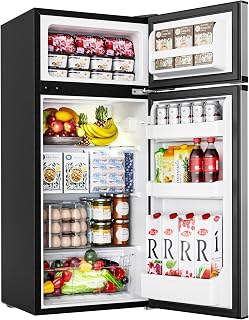
EUHOMY 4.5 Cu. Ft. Mini Fridge with Freezer, 2 Door
For suite-style or apartment housing where the larger cap applies. The separate freezer door keeps frozen food properly separated from the fridge section, which the single-door designs above cannot do. Two things to check before ordering. First, it is 42.9 inches tall, taller than several schools allow and taller than Baylor’s 36-inch limit. Second, this model is not listed in the EPA’s ENERGY STAR certified product database, so it is not the right choice at a school that requires certification. Price checked August 2026: about $270.
For the rest of the appliance picture before move-in, see our guides on dorm microwave rules, coffee makers, air fryers, and the complete dorm packing list.

4-Tier Over-the-Fridge Storage Stand (White)
A mini fridge eats floor space and leaves the air above it unused. This four-tier stand sits over the fridge and turns that vertical space into shelves. The height adjusts, so measure your chosen fridge first and confirm the stand clears it.
Still deciding between models? Our full dorm mini-fridge guide compares refrigerator space, freezer design, ENERGY STAR certification, dimensions, door configuration, defrost type, and published noise ratings. Compare the best mini fridges for dorm rooms →
Setup and Safe Use
Follow the manufacturer’s instructions before plugging it in. If the refrigerator was transported on its side, the required settling time varies by model, and the manual will state it. Whenever possible, transport a compact refrigerator upright so the question does not arise.
Follow the manufacturer’s required ventilation clearances. Compact refrigerators need airflow to dissipate compressor heat, but the required spacing varies by model, and some are rated for tighter installation than others. UCLA separately prohibits operating a mini fridge in a closet or enclosed area, so check the housing policy as well as the manual.
Check whether your school requires a direct wall connection. Boston University and Baylor both state that a refrigerator must be plugged directly into a wall outlet rather than a power strip. Other schools do not address it. Follow both the university policy and the manufacturer’s instructions, since they can differ. Our guide to dorm power strips and surge protectors covers what schools require for everything else in the room.
Set the thermostat to the middle setting first. Most compact refrigerator thermostats are labeled 1 to 7, or Min to Max, with no temperature readout. Start in the middle, then adjust after 24 hours at operating temperature based on how cold it actually keeps things.
Do not overfill it. A packed mini fridge has poor internal air circulation, which causes uneven temperatures. Items at the back may freeze while items in the door barely stay cold. Leave space for air to move, especially around the cooling plate.
Clean it out at the end of each semester. Empty the fridge completely during breaks, wipe down the interior, and prop the door open so it can air out. A fridge left full and sealed over a month-long break develops odors that are difficult to remove.
One inexpensive add-on worth buying
Most compact refrigerators do not show the exact interior temperature, and the numbered dial tells you nothing about what the fridge is actually holding. An inexpensive refrigerator thermometer makes it easy to verify that food is being stored at 40°F or below, which is the threshold the FDA uses for safe refrigerated storage. It is a useful check in a dorm room, where the door gets opened constantly and the fridge is often the only place medication and leftovers can go.
Tru Temp Refrigerator and Freezer Thermometer
A simple dial thermometer that hangs on a shelf or stands on its own. No batteries, nothing to set up. Price checked August 2026: about $7.
Related: Easy dorm meals and dorm food ideas, no kitchen required
FAQ
What size mini fridge is best for a dorm room?
A 3.1 to 3.2 cu. ft. refrigerator suits most students in a standard room, because it holds roughly a week of food and drinks and sits under the caps published by many schools. It is not universally allowed. Verify your student’s residence-hall limit first, since several schools cap lower and several supply a unit and ban personal fridges entirely.
Is a 4.5 cu. ft. fridge too big for a dorm?
It depends entirely on the school. Among the 22 policies verified for this guide, a 4.5 cu. ft. unit is permitted at Michigan State, Michigan, UCLA, Florida, and for upperclass students at Virginia. It exceeds the published cap at Boston University, Northeastern, Maryland, Clemson, Wake Forest, and NYU. Several other schools prohibit personal refrigerators at any size. Height is a separate problem, since 4.5 cu. ft. models commonly run over 40 inches tall.
What are the dimensions of a typical dorm mini fridge?
Dimensions vary by model and capacity, and two fridges with identical cubic-foot ratings can have very different footprints. As a reference point, the three models in this guide measure 19.4, 33.3, and 42.9 inches tall at 1.6, 3.2, and 4.5 cu. ft. respectively. Compare the actual exterior dimensions on the listing against the space available in the room, and check the housing assignment materials for desk and bed clearances.
Is a 3.2 cu. ft. fridge big enough for a dorm?
For one student, yes in most cases. It holds drinks, condiments, produce, and several days of leftovers, plus a small freezer compartment on most models. It is usually not enough for two students sharing, or for a student who cooks and meal-preps regularly. Confirm your school’s limit before buying, because a 3.2 exceeds Wake Forest’s 3 cu. ft. cap.
Can a dorm mini fridge have a freezer?
Usually yes, but check how your school measures capacity. Some schools count refrigerator and freezer capacity together in a single cubic-foot figure, which means a model advertised at 3.2 cu. ft. total may be measured differently than you expect. Wisconsin separately prohibits stand-alone freezers. Also note that a small chiller compartment inside the main door is not the same as a separate-door freezer.
Can roommates have two mini fridges?
Policies differ, and several schools regulate per room rather than per student. UT Austin, UCLA, Baylor, and Michigan all state a one-per-room or one-per-bedroom rule, so two roommates cannot each bring one. Other schools are silent on the question. Coordinate with the roommate before move-in either way, since two refrigerators in a standard double is a practical problem even where it is permitted.
Can you put a mini fridge under a dorm bed?
It depends on three things: the actual clearance under the lofted or raised bed, the ventilation clearance the appliance manufacturer requires, and whether the school allows it. Measure the clearance rather than assuming, since loft heights vary by hall and by bed frame. Check the manual for required airflow around the unit, and check the housing policy, since some schools restrict where an appliance may be operated. UCLA, for example, prohibits running a mini fridge in a closet or enclosed area.
Can you put a microwave on top of a mini fridge?
Verify before doing it. Check the refrigerator manufacturer’s guidance on placing weight on the unit, the microwave manufacturer’s clearance and ventilation requirements, the combined weight and stability of the stack, and the housing policy, which at many schools prohibits a personal microwave in the first place. Where the school supplies or requires a combination MicroFridge unit, the question does not arise, because the appliances are engineered to work as one.
Does a dorm mini fridge need to be ENERGY STAR certified?
Some schools require it, some recommend it, and some do not mention it. Michigan State strongly recommends ENERGY STAR without requiring it. Where a policy does require certification, confirm the exact model number in the EPA’s certified product database rather than trusting a retailer listing, since certification applies per model and not per brand.
Can I plug a mini fridge into a surge protector in a dorm?
University and manufacturer requirements vary, and students should follow both. Boston University and Baylor explicitly require a direct wall connection. Other schools in this guide do not address it. Check the housing policy for your student’s hall and the instructions that come with the appliance before deciding.
Does my school require a MicroFridge?
Check the policy table above, which distinguishes schools that provide a unit, schools where renting is optional, and schools where it is required. South Carolina requires one campus-wide and Virginia requires one of first-year students. For schools not listed, use the Dorm Packing List Generator or contact residential life directly.
📌 Also see: Dorm Power Strips and Surge Protectors: What Schools Actually Require, plus our move-in day checklist and back to college shopping list.
Check every appliance rule for your student’s school before you buy anything.
The Dorm Packing List Generator shows mini fridge, microwave, and coffee maker policies for 100+ schools, with a personalized checklist you can print and bring to move-in day.
UniversityParent Team