

How to Keep Your College Student’s Valuables Safe in the Dorm (What to Buy Before Move-In Day)
This post contains affiliate links. If you purchase through our links, we may earn a small commission at no extra cost to you. We only recommend products we would tell our own family to buy.
Somewhere between the excitement of buying bedding and the stress of figuring out FAFSA, dorm room security rarely makes it onto the move-in day checklist. Then something goes missing.
It might be a laptop left on a desk during a bathroom break. A wallet on a dresser during a floor party. Medications from an unlocked drawer. Dorm rooms, libraries, dining halls, and recreation centers all create opportunities for phones, laptops, bikes, wallets, and other belongings to disappear. A few simple habits can reduce the risk.
The good news: a small investment before move-in day dramatically reduces the risk. This guide walks you through exactly what to buy, what to skip, and what to tell your student before they unpack.
Jump to
- What actually gets stolen in dorms
- Secure storage options (with product picks)
- Laptop and electronics security
- Valuables worth leaving at home
- The anti-theft backpack worth knowing about
- Trackers worth buying
- What to tell your student
- Don’t skip this: renters insurance
- What to do if something is stolen
- Frequently asked questions
Quick answer
The best dorm security setup combines habits with simple protection: lock the door every time your student leaves, keep medications and important documents in a locking box, photograph serial numbers before move-in, keep valuables out of sight, and check your insurance coverage. A dorm safe helps with the second part. It doesn’t replace the first.

What actually gets stolen in dorms
Campus police reports consistently show the same categories: laptops and tablets, headphones and earbuds, cash and gift cards, prescription medications (ADHD medications especially), and occasionally phones. Jewelry, passports, and Social Security cards show up less often but are devastating when they disappear.
The majority of dorm theft happens when rooms are unlocked, not forced. A propped hallway door, a student who stepped out “just for a minute,” or a floor social where people drift in and out are the most common setups. Your student’s roommate being a good person does not protect against everyone else who has access to a shared space.
ADHD medications, sleep aids, and prescription painkillers are among the most commonly stolen items in dorms. They’re small, valuable on the street, and easy to pocket. A locking pill safe or portable lock box is not excessive, it’s just practical.
One email a week, for parents doing this right now
The deadlines, checklists, and conversation scripts that actually matter at each stage of the year. Free, and you can unsubscribe anytime.
Looking for the free toolkits? They are on our resources page, no email required.
Secure storage options
Does my student need a dorm safe?
Not every student needs a full safe, but almost every student needs something that locks. A locking box or safe is not a guarantee. It’s a deterrent that makes casual theft harder and buys time, and tethering it to a bed frame or desk leg (see the FAQ below) is what makes that deterrent real. Here’s a quick way to match your student’s situation to the right approach:
| Student situation | Best approach |
|---|---|
| Laptop, wallet, passport, small valuables | Compact lockbox or safe |
| Expensive electronics used every day | Good habits, device tracking, and insurance |
| Shared suite or frequent visitors | Lockable storage |
| Bicycle | Quality bike lock and registration |
| Sentimental or irreplaceable item | Leave it at home |
| Student unlikely to use a safe consistently | Focus on habits before buying more gear |
The phrase “dorm safe” covers a wide range of products at very different price points. Start with the problem you’re solving: a portable lock box ($20-40) handles medications, cash, passport, and a spare card. A larger chest safe protects a laptop when it’s not in use. A locking ottoman or trunk solves the larger-storage problem for students with limited closet space. You don’t need all three.
For medications, cash, and small valuables
This is the category most parents skip and most regret. ADHD medications and prescription painkillers are among the most frequently stolen items in dorms. A $25 lock box fixes this completely.

Combination Medication Lock Box
The right size for a 30-day pill supply, an EpiPen, or a few small valuables. No key to lose. Combination reset is easy. Light enough to fit in a nightstand drawer or tuck behind books on a shelf. This is the one item we’d call non-negotiable for any student on a prescription.
~$20-30
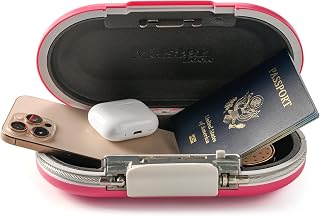
Master Lock Portable Safe, Pink (5900DPNK)
Compact, cute, and genuinely functional. Combination lock, fits a phone, passport, cash, and small jewelry. Good for travel (spring break, study abroad) as well as the dorm room. The pink version is consistently well-reviewed as a move-in gift from parents.
~$25-35

RPNB Biometric Safe Box
Fingerprint access means no key to lose and no combination to forget under pressure. Backlit touchpad, emergency Type-C port if the battery dies, pre-drilled mounting holes. Alloy steel construction. A step up in both price and security for students with expensive medications or jewelry.
~$60-80
For laptops, documents, and larger valuables

SentrySafe Fireproof Safe Box with Key Lock
Fireproof protection for documents, a hard drive, passport, and small valuables. Key lock keeps it simple. Carrying handle makes it easy to tuck under a lofted bed or inside a closet shelf. Not large enough for a full laptop, but a solid choice for protecting irreplaceable documents and backup drives.
~$45-65

Vaultz Locking Storage Trunk
A full-size lockable trunk that fits under a lofted bed and holds a laptop, textbooks, chargers, and anything else worth protecting. Combination lock included. It’s large enough to be genuinely useful as both a storage container and a security solution. Good for students with a lot to protect.
~$60-80
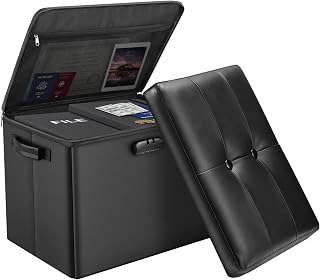
DocSafe Locking Storage Ottoman (Fireproof)
A locking ottoman that does double duty as seating and a fireproof, waterproof document safe. 17 inches tall, folds flat for moving. Handles make it portable between the dorm and home. Good for students in doubles where floor space is tight and every piece of furniture needs to earn its spot.
~$55-75
Almost every school prohibits drilling into walls, floors, or university-owned furniture. That rules out bolt-mounting a safe. The workaround: run a steel security cable through the tether point on the safe and loop it around the metal frame of a lofted bed or a permanent desk leg. It won’t stop a determined thief with tools, but it stops a casual grab.
Hidden storage worth considering
Diversion safes (items disguised as everyday objects) are a useful second layer, not a primary security solution. A casual thief who opens a door, grabs what they can see quickly, and leaves will miss a book safe on a bookshelf. Someone invited into the room will probably find it eventually. Use it for a backup card or spare cash, not for anything you’d be devastated to lose.
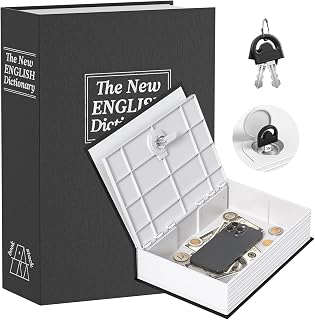
KMC Dictionary Diversion Book Safe
A real hollowed-out book with a key lock and a metal interior. Better for cash and backup cards than for electronics. Place on an actual bookshelf among real books. The key-lock version is more secure than the magnetic-latch style. Not a primary safe, but a smart backup for things you want accessible without opening a combination lock.
~$25-35
Valuables worth leaving at home
The safest item is the one that never travels to campus. Before move-in day, it’s worth going through a short list of things that usually cause more stress than they’re worth in a dorm room:
- Expensive or sentimental jewelry. A family heirloom isn’t replaceable. Leave it in a home safe or deposit box instead.
- Large amounts of cash. A debit card or a payment app does the same job without the risk.
- Original irreplaceable documents. Bring a copy of a birth certificate or Social Security card only if the school specifically requires the original for a form. Otherwise it belongs in the family document vault at home.
- A second or old laptop “just in case.” Extra electronics are extra targets with no real upside.
- Anything that can’t be replaced. If losing it would be devastating rather than just annoying, that’s the test. Leave it home.
None of this is about assuming the worst. It’s the same logic as not packing your entire jewelry box for a trip: less to protect means less that can go wrong.
Laptop and electronics security
Most laptops have a Kensington lock slot (a small rectangular hole on the side or back of the machine). If your student’s laptop has one, a cable lock is a $30-35 fix that turns the laptop into something that can’t be quickly pocketed. It won’t stop a determined thief with a bolt cutter, but it stops the opportunistic grab.
Check your student’s laptop model before buying. MacBook Air and MacBook Pro models from 2016 onward do not have a Kensington slot. Most Windows laptops (Dell, HP, Lenovo ThinkPad and IdeaPad lines) still include one.

Kensington MicroSaver 2.0 Twin Cable Lock (K65048WW)
The twin version includes two keyed cables, so your student can secure both a laptop and a monitor or second device at the same time. Rotating locking head reduces stress on the port. Key lock, no combination to forget. Fits the standard Kensington security slot found on most Windows laptops. Takes about 30 seconds to set up and loop around a desk leg or bed frame post.
~$35-50
For MacBooks and other laptops without a lock slot, the better approach is a combination of a locking safe (when not in use at a desk) and a tracker (see below). A cable without a slot is useless.
The anti-theft backpack worth knowing about
If your student carries their laptop and valuables across campus daily, a bag with built-in security features is worth considering. Most standard backpacks leave zippers fully exposed and accessible to anyone walking behind your student. Anti-theft designs reverse that.
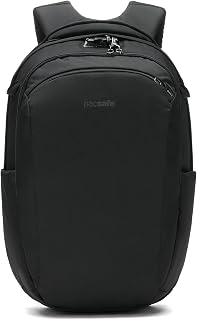
Pacsafe V 26L Anti-Theft Tour Backpack
The Pacsafe V series uses cut-resistant material, lockable zippers, and hidden pockets designed specifically to defeat pickpockets and bag slashers. The 26L size comfortably fits a 15″ laptop, textbooks, and a day’s worth of gear. Good for students who travel for spring break or study abroad, and equally useful on a busy campus with crowded lecture halls.
~$90-120
Trackers worth buying
A tracker won’t prevent theft. But it significantly improves the odds of recovery, which is a reasonable consolation when a $1,200 laptop disappears two weeks into the semester. Both options below have large enough user networks that they work reliably in dense college town environments.

Apple AirTag 2nd Generation (4-Pack)
If your student has an iPhone, AirTags are the most accurate tracking option available. The 4-pack gives you one for the laptop bag, one for a backpack, one for keys, and a spare. The 2nd-generation model uses an upgraded Ultra Wideband chip with up to 1.5x greater Precision Finding range than the original, plus a louder built-in speaker for locating it by sound. Tap each one inside a bag pocket or attach to a key ring. Battery lasts about a year.
~$79-99
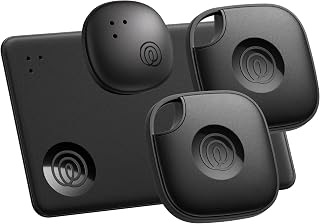
Life360 Tile Essentials 4-Pack (Mate/Slim/Sticker)
Works on both iPhone and Android via the Life360 app. The 4-pack includes Mate, Slim, and Sticker form factors, covering a backpack, a wallet, a laptop, and a set of keys. Loud ring helps locate nearby items. Solid network coverage in urban campus environments. Good choice for Android users or families already using Life360 for location sharing.
~$50-70
Laptop bag inner pocket (not the main compartment a thief would check). Backpack inner sleeve. A small piece of tape holds an AirTag to the inside lid of a laptop. For a passport or wallet, a card-format tracker like Tile Slim works better than the disk version.
What to tell your student before move-in day
The equipment helps, but the habits matter more. Here are the conversations worth having:
| The habit | Why it matters |
|---|---|
| Lock the door every single time | Even for a 60-second bathroom trip. Most dorm theft happens when a room is briefly unlocked. Make it automatic, not situational. |
| Never prop the hall door for convenience | Propped exterior doors are the most common way non-residents enter residence halls. It feels like a community favor. It isn’t. |
| Don’t leave a laptop visible and unattended in the library | Library thefts spike every fall semester. “I’m just going to get a snack” is all it takes. The cable lock goes in the bag. |
| Serial numbers matter | Photograph the serial number of every valuable item before unpacking. A recorded serial number can help campus police or a pawn database identify a recovered item. It doesn’t guarantee recovery, but it’s the detail that makes recovery possible at all. |
| The “nice people” problem | Most college students are trustworthy. A small number are not. Your student cannot predict which category applies to the friend-of-a-friend who ends up in their room. The safe is for that small number. |
Parent Tip
Before your student unpacks a single box, walk the room together and take a short video, narrating anything already scuffed, stained, or broken. Most housing damage disputes come down to your word against the school’s move-out inspection, and thirty seconds of video on move-in day settles that argument before it starts. Save it somewhere you can find it in nine months, not just on the phone your student may lose.
For longer absences, store the big items instead of hauling them home
For summer break or a semester abroad, the safest place for the things they cannot take with them, the mini-fridge, the TV, the bike, is a nearby storage unit rather than a friend’s basement. SpareFoot compares student storage facilities near campus so the pricey items stay locked up and out of a stranger’s reach.
Find student storage near campus →
We may earn a small commission if you book through this link, at no extra cost to you.
Don’t skip this: renters insurance
Before buying a single lock or safe, check your homeowners or renters insurance policy. Many homeowners policies extend some personal property coverage to a student living away at college, often subject to an off-premises limit. Coverage, deductibles, and limits vary by policy, so it’s worth checking your own before assuming a stolen laptop is covered.
Call your insurance agent before move-in day and ask three specific questions: Is my student’s dorm room property covered under our existing policy? What is the sub-limit for off-premises personal property? What is the deductible that applies?
If the answer to the first question is no, a standalone renters insurance policy is worth considering. GradGuard says renters coverage can cost about $15 per month, although pricing varies by policy and location. Coverage typically includes theft, accidental damage, and water damage (when a neighboring student’s bathroom overflows), which makes it worth a look for a student carrying a laptop, a tablet, earbuds, and a camera.
If your student is heading to an off-campus apartment instead of a dorm, renters insurance moves from recommended to essential. Our First Apartment Checklist covers the full setup.
Walk through the room with your phone before move-in is complete and photograph every valuable item with its serial number visible. Save the photos somewhere other than the device itself (cloud backup, email to yourself). A claim without documentation is a claim that takes much longer to process.
Affiliate partner. If you buy through this link we may earn a commission, at no extra cost to you.
Considering GradGuard? You can get a college renters insurance quote in about two minutes, with tuition insurance available as an add on.
What to do if something is stolen
Move fast, and keep your student’s safety the priority over recovering the item.
- Contact campus police right away. Not residence life, not a roommate conversation first. A police report is also what most insurance claims require.
- Give them the make, model, and serial number if you photographed it beforehand.
- Tell residence hall staff so they can flag it and check for any relevant camera coverage in shared spaces.
- Use the device’s own lost-mode or Find My feature if it has one. This can show a last known location and lock the device remotely.
- Don’t personally confront a suspected thief or use tracker data to go looking for the item alone. Hand that information to campus police instead.
- Change passwords on anything that was logged in on the device.
- Call the bank or card issuer right away if a wallet or cards are missing.
- File the insurance claim once the police report exists, using the photos and serial number from your move-in documentation.
Most of this only works if your student’s belongings were documented before move-in. Photograph serial numbers and save the photos somewhere other than the device itself, a cloud backup or an email to yourself works.
Frequently asked questions
Are dorm safes actually effective, or can someone just take the whole thing?
A portable safe without a tether is mostly a deterrent against casual snooping, not determined theft. A safe with a quality steel security cable looped around a bed frame or desk post takes tools and time to remove. The goal is to make theft harder than the alternatives in the same room, which is usually effective enough. Most dorm theft is opportunistic, not planned.
What if my student’s school doesn’t allow drilling into walls or furniture?
Almost none of them do. The tether cable approach described above is the standard workaround. Loop the cable through the safe’s tether ring and around the metal frame of a lofted bed or a permanent desk leg. No drilling required, no damage to university property.
Should I buy a combination lock or a key lock for a portable safe?
Combination, with one important step: write down the combination and keep a copy at home (not in the dorm room). Lost key situations are more disruptive than forgotten combinations, and keys can be stolen or copied.
Can my student put an AirTag in their laptop bag without someone detecting it?
iPhone users who pick up a bag with an unknown AirTag in it will receive a notification after a period of time (Apple’s anti-stalking feature). In a theft scenario, this means a thief who keeps the bag may be alerted before your student can contact campus police. The tracker still works, but move fast if something goes missing. Android users won’t receive the same notification unless they have the Tile app installed.
What’s the most important thing to secure first?
Prescription medications, then the laptop. Medications are small, high-value on the street, and frequently taken in dorms. A $35 portable lock box solves that problem completely. The laptop is usually the highest-dollar item and the one most likely to be grabbed during a quick, unlocked-door theft.
My student is sharing a room with a stranger. Should I be worried about their roommate?
The vast majority of roommate situations are fine. But the honest answer is that you don’t know this person yet, and neither does your student. A locking safe is not an accusation. It’s the same principle as not leaving cash visible anywhere. Once your student has known their roommate for a few weeks, they’ll develop their own read on the situation. Until then, the safe is a reasonable precaution, not a statement of distrust.
Does my homeowner’s insurance cover my student’s dorm room belongings?
Often yes, but with a sub-limit and a deductible that may make small claims not worth filing. Call your agent before move-in and ask specifically about off-premises personal property coverage for a dependent college student. If coverage is inadequate, a standalone renters insurance policy typically costs around $15 per month, though pricing varies by provider and location, and covers theft, accidental damage, and water damage.
The right setup for most students is simple: one portable lock box for medications and small valuables (tethered to the bed frame), one cable lock for the laptop bag, and AirTags or Tile trackers in the bags they carry daily. Add renters insurance if your existing homeowner policy doesn’t extend coverage. Total cost is under $150, and it takes about 20 minutes to set up on move-in day.
The harder part is the conversation. Let your student know why these things matter without making them feel like they’re heading into a dangerous environment. The message is simple: most people are great, a small number are not, and the safe is for that small number. Then help them set it up and move on to more exciting things.
For a complete list of what to pack before move-in, see our Dorm Packing List.
Free Download: Emergency Preparedness Card
Serial numbers, insurance policy info, campus emergency contacts, and a 3-step theft-reporting checklist. Print it out and put a copy in the safe before move-in day.
Download Free (no email required)