

Electric Kettle Dorm Rules: What’s Allowed, What’s Not, and Our Top Picks for 2026
An electric kettle is one of those items that seems completely harmless, until your student’s RA confiscates it at fall move-in. The policy landscape for kettles is genuinely messier than microwaves: some schools ban them outright (they’re categorized as “heating appliances” alongside hot plates), others allow them only in suite kitchens, and many allow them freely as long as the unit has an automatic shut-off and a concealed heating element.
Buying the wrong model, or buying one for a school that bans them entirely, is an easy and avoidable mistake. This guide covers how to check your school’s policy, what the safety requirements mean in practice, which schools are known to restrict kettles, and the compact models that give your student the best chance of compliance.
Jump to section
Disclosure: This post contains affiliate links. If you purchase through our links, we may earn a small commission at no extra cost to you. We only recommend products we’d actually suggest to our own kids’ parents.
New research: 17 of the 101 universities we analyzed ban electric kettles, including Yale, UCLA, and Maryland. See the full findings in our dorm appliance rules study.
Does Your School Actually Allow an Electric Kettle?
Here’s where kettles differ from microwaves: at most schools, microwaves are specifically listed (allowed or banned) in the housing handbook. Kettles often aren’t, they fall into the gray zone of “heating appliances,” a category that can include hot plates, coffee makers, rice cookers, and anything else that generates heat.
When housing staff conduct move-in inspections, they’re looking for anything with an exposed heating element or anything that could be left running unattended. A kettle with a concealed element and automatic shut-off reads very differently than a coil-based travel kettle, even if the written policy just says “no heating appliances.”
The safest approach is to look up your school’s “prohibited items” list in the residence hall handbook (Google “[school name] residence hall prohibited items 2026”) and then look at the “permitted items” list. If kettles are on the permitted list, you’re fine. If they’re not mentioned at all, call residential life and ask specifically about “electric kettles with automatic shut-off”, the answer matters before you spend money.
The four policy tiers schools typically fall into
1. Kettles explicitly allowed. The school lists electric kettles as permitted items, usually with safety requirements (auto shut-off, concealed element, UL certification). Many mid-size state schools and liberal arts colleges fall here. Your student is fine, just buy a compliant model.
2. Kettles allowed by implication. The school doesn’t list kettles specifically but allows “single-serve coffee makers” and similar low-risk appliances. A compact kettle with safety features usually flies under the same umbrella. Still worth confirming with residential life.
3. Kettles restricted to common areas or kitchenettes. Common at schools with dense urban dorm buildings where room circuits are tightly managed. Your student can still use a kettle, just not in the room. Suite-style or apartment housing on the same campus is often more permissive than traditional corridor dorms.
4. Kettles banned outright. Some schools prohibit all personal heating appliances in rooms, with kettles explicitly named or captured under the “hot plate equivalent” language in the handbook. This is most common at schools with older electrical systems, dense urban campuses, and schools with a history of dorm fire incidents. At these schools, common area microwaves and hot water dispensers in dining facilities are the practical alternatives.
One email a week, for parents doing this right now
The deadlines, checklists, and conversation scripts that actually matter at each stage of the year. Free, and you can unsubscribe anytime.
Looking for the free toolkits? They are on our resources page, no email required.
What Schools Actually Check For at Inspections
If your school allows kettles with restrictions, the two features that matter most to housing staff are:
Automatic shut-off with boil-dry protection. This is the single most important feature for dorm compliance. A kettle that shuts off automatically when the water boils (and also when it runs dry) eliminates the primary fire scenario: someone forgets the kettle is on, water boils away, exposed element overheats, fire starts. Every kettle we recommend below has both. Some schools explicitly require a shut-off; others just confiscate anything that looks like it could be left running indefinitely.
Concealed or enclosed heating element. Older coil-style kettles (the ones that look like a small pot with a metal coil inside) are a red flag for housing staff because the element is exposed and visible. Modern kettles with the heating element hidden in the base or fully enclosed in the body read as substantially lower-risk, and they look like a coffee maker rather than a hot plate. If you’re shopping at a hardware store and see a travel kettle with a visible coil, skip it.
Secondary factors housing staff may check: UL certification marking, capacity (very large units suggest extended heating sessions), and whether the unit has a temperature control setting that could imply sustained use at lower temperatures.
Features That Matter (and What to Skip)
What to look for
Capacity: 0.8-1.7L. A 1L kettle holds enough for 3-4 cups of tea or ramen and takes about 2-3 minutes to boil. A 1.7L model is larger but still compact. Anything under 0.8L will feel limiting for daily use. Anything over 2L is likely to raise eyebrows at an inspection and takes longer to heat.
Wattage: 1000-1500W. Most dorm-safe kettles draw 1000-1500W. This is meaningfully less than a microwave, so circuit load is less of a concern, but still plug into a wall outlet rather than a shared power strip, especially if a mini-fridge is on the same circuit. 1500W boils faster; 1000W is slower but safer on older circuits.
360-degree cordless base. Lets you pick up the kettle from any angle, which matters more than it sounds when you’re working in a 12×12 dorm room. The cord stays at the base; the kettle itself lifts off freely.
Stainless steel or glass interior. BPA-free interiors prevent plastic taste in the water. Stainless steel is more durable for dorm use; glass lets you watch the water boil (useful for certain teas where you want to stop before a full boil). Both are easy to clean and don’t retain flavors.
Variable temperature (nice to have). Premium models let you set a target temperature: 175°F for green tea, 195°F for pour-over coffee, 212°F for black tea or ramen. It’s genuinely useful if your student is into coffee or loose-leaf tea. Not necessary for a first-year student who just wants hot water for instant noodles.
What to skip
Exposed coil models. These are typically cheaper and found at hardware stores. Skip them, they’re a compliance risk and a burn risk.
Very high wattage (>1800W). These boil faster but are more likely to trip a dorm circuit, especially in older buildings. There’s no meaningful practical benefit for dorm use.
Large capacity (>2L). Oversized for a dorm desk, harder to store, and signals heavier use to housing staff during inspections.
Stovetop kettles. Unless your student has a private kitchen, there’s no stove to use them on. They also can’t self-shut-off.
School-by-School Quick Reference
The table below is based on publicly available housing policies as of 2026. Verify directly with your school before buying, policies change, and enforcement varies by building and RA.
| School | Kettle Policy | Notes |
|---|---|---|
| UCLA | Banned | One of the strictest policies: kettles and coffee makers both banned in rooms. One of few schools to explicitly prohibit both. |
| UConn | Banned | Explicit policy ban on electric kettles in rooms. Floor kitchenettes available. |
| Northwestern University | Banned | Hot pots and kettles explicitly prohibited. Dense residential district fire code. |
| Yale University | Banned | Permitted list includes only microwave and mini-fridge. Kettles not listed as allowed. |
| Carnegie Mellon University | Kitchen areas only | Heating appliances restricted to designated kitchen areas, not individual rooms. |
| UC Santa Barbara | Banned | No personal cooking equipment including coffee makers in rooms. Very strict policy. |
| UC San Diego | Banned in rooms | “Water boilers” explicitly banned in rooms. Community kitchens available in each building. |
| TCU | Banned | Kettles banned alongside microwaves in rooms. |
| Tufts University | Restricted | Only coffee makers specifically exempted from the heating appliance ban; kettles not listed as permitted. |
| University of Minnesota | Varies | Kettle policy ambiguous, cooking ban language unclear for water-only appliances. Check your specific hall. |
| BYU | Allowed | Kettles allowed (herbal tea and hot water for cooking not prohibited by Honor Code). Coffee makers banned. |
| University of Oregon | Allowed with auto shut-off | Electric kettles with automatic shut-off explicitly permitted. One of the more specific and permissive written policies. |
| Brandeis University | Allowed with restrictions | Auto shut-off required. Concealed element strongly preferred. Verify current handbook. |
| Washington University in St. Louis | Allowed with conditions | Permitted with safety features. Confirm with your specific residence hall. |
| Most large state universities | Generally allowed | Auto shut-off and UL certification typically required. Confirm your building-specific rules. |
For a school not listed here: search your housing handbook for “prohibited items” and “heating appliances.” If kettles aren’t mentioned, call residential life and ask specifically about “electric kettles with automatic shut-off.” Use our Packing List Generator to cross-check appliance policies for 75+ schools in one place.
Our Top Picks for 2026
All four models below have concealed heating elements, automatic shut-off, boil-dry protection, and UL certification, the checklist that satisfies the strictest permissive policies. We’ve included options at different price points and capacity ranges.

Chefman Rapid-Boil 1L Electric Kettle
The go-to recommendation for tight dorm setups. Boils in about 3 minutes, auto shut-off with boil-dry protection, concealed element, 360-degree cordless base. Stainless steel interior keeps the water tasting clean. Under $35 and compact enough to fit next to a laptop. Handles tea, ramen, oatmeal, instant coffee, basically everything a first-year student actually uses a kettle for.
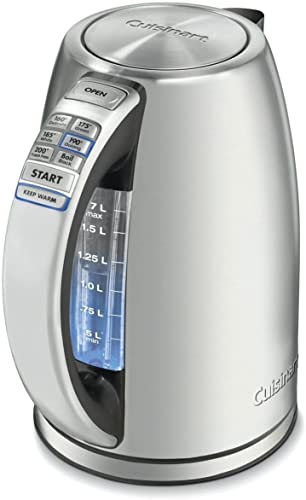
Cuisinart PerfecTemp 1.7L Variable Temperature Kettle
The gold standard for students who care about their tea or coffee. Six preset temperatures (160°F-212°F), 30-minute keep-warm, auto shut-off, concealed element, stainless steel, 3-year warranty. Consistently top-rated in independent tests for accuracy and reliability. Larger footprint than the Chefman but still dorm-appropriate. Around $70-$80. If your student is into loose-leaf tea, pour-over coffee, or matcha, this is the one to buy.

Hamilton Beach Compact Electric Kettle 1L
Hamilton Beach has been making reliable small appliances for decades, which matters at this price point. Auto shut-off, boil-dry protection, concealed element, 360-degree base. Nothing fancy, just a solid, safe kettle that works. Good choice if your student just needs hot water and doesn’t want to spend more than $25-$30. Widely available at Target and Walmart as well as Amazon.
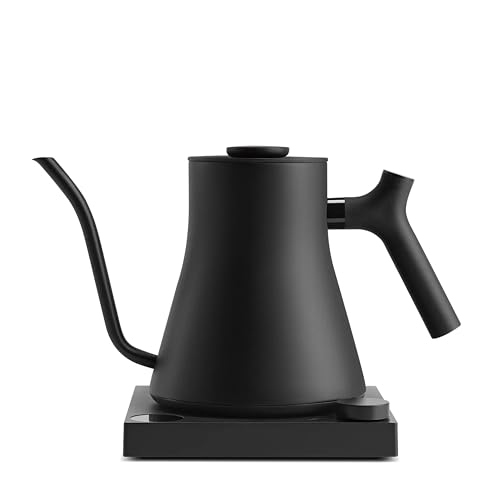
Fellow Stagg EKG Gooseneck Kettle 0.9L
For the student who brings a pour-over setup to college. Precise temperature control (degree-by-degree), built-in brew stopwatch, keep-warm up to 60 minutes, matte finish, under 1L for compact storage. More expensive ($165-$185) but it’s a genuine appliance for someone serious about coffee. Fully enclosed element, auto shut-off, and the gooseneck spout makes it obviously “not a hot plate” to housing staff. Also available in a smaller EKG Go travel version for tighter spaces.
See our complete dorm packing list and our guide to dorm microwave rules for the full picture on what to bring, and what to leave at home.
Safe Use Tips Once You’re There
A compliant, quality kettle can still cause problems if used carelessly in a shared space. A few habits worth establishing early:
Always use it with someone awake in the room. The automatic shut-off is the safety net, not the intended substitute for attention. In practice, most incidents happen when a student starts the kettle, gets distracted, and leaves the room, then the auto-off kicks in on an empty kettle. Build the habit of staying put until it’s done boiling.
Plug directly into the wall. Not a shared power strip with the mini-fridge or laptop charger. The kettle draws 1000-1500W at full boil, brief but significant. If you must use a strip, use a quality surge protector rated for major appliances, not a basic one.
Descale every few months. Hard water leaves mineral deposits inside the kettle that affect taste and heating efficiency. A 1:1 mix of water and white vinegar, boiled inside the kettle and left for 20 minutes, then rinsed out twice, handles it. If the water at your student’s school is hard (common in the midwest and southwest), do this monthly.
Only boil water. Don’t use the kettle to heat soup, ramen broth, or anything other than plain water. Residue from other liquids is hard to clean out and affects the auto-shutoff float mechanism in some models.
Check the cord and base before each semester. A bent or frayed cord or a cracked base plate needs to be replaced, not ignored. Kettles are inexpensive enough that a worn-out unit should just be replaced rather than repaired.
FAQ
Are electric kettles allowed in dorms?
It depends entirely on the school. Many allow them with requirements: auto shut-off, concealed heating element, UL certification, and a capacity under 2L. Others ban all heating appliances in rooms, including kettles. Check your specific school’s housing handbook under “prohibited items” or “permitted appliances” before buying.
What wattage kettle is safe for a dorm?
1000W-1500W is the standard range for dorm-safe kettles. A 1500W kettle boils water faster; 1000W is slower but draws less current. Either is acceptable on most dorm circuits if plugged directly into a wall outlet. Avoid models over 1800W in older buildings.
What’s the difference between a travel kettle and a dorm kettle?
Travel kettles are often designed for use with different voltage systems (110V and 220V) and are frequently coil-style with an exposed heating element. Dorm-safe kettles are designed specifically for single-voltage US use with a concealed base element and automatic shut-off. The coil-style design is a red flag for housing staff, stick with modern base-element cordless models.
My school says “no heating appliances.” Does that include a kettle?
Probably, but it’s worth calling residential life and asking specifically. Framing matters: “We were wondering if a compact electric kettle with automatic shut-off and a concealed heating element is covered by the heating appliance ban, or if that refers primarily to hot plates and open coils.” Some schools interpret “heating appliances” as open-coil devices only; others apply it broadly. Get the answer in writing if possible, an email confirmation protects your student at inspection.
Is microwaving water a good substitute for a kettle?
It works, but it’s slower and uneven. More practically, microwaved water can “superheat”, reach boiling temperature without actually boiling, then erupt suddenly when disturbed. This is a burn risk. For making tea or ramen, a kettle is meaningfully safer and faster. If your school bans kettles entirely, the microwave is the default fallback, but it’s worth knowing the superheating risk and letting your student know not to put a spoon or tea bag directly into just-microwaved water.
Can I bring a Keurig instead?
Keurigs are permitted at more schools than electric kettles because they’re seen as single-serve coffee makers rather than open-ended heating appliances, and they have automatic shut-off by design. If your school bans kettles but allows Keurigs, a Keurig can function as a hot water source (run it without a pod). It’s a reasonable workaround. Some schools explicitly permit “single-serve coffee makers” while banning “electric kettles”, the distinction is made on fire safety grounds, not logic.
What should my student do if their RA confiscates the kettle?
Confiscated appliances are typically held in a housing office and returned at the end of the year. Your student can contest a confiscation if their kettle meets the listed requirements and the RA is applying the policy inconsistently, but pick the battle carefully. Housing staff have discretion, and a documented conversation about compliance tends to end better than an appeal. If the kettle was compliant and confiscated in error, have your student email the housing office (not the RA directly) with the model specs and a copy of the permitted-items policy language.
Do kettles with temperature control get flagged differently?
Generally no. Temperature control features (variable temp, keep-warm) don’t typically affect compliance status, housing staff are looking at the heating element style, auto shut-off, and capacity, not the control panel. That said, a kettle with a 60-minute keep-warm setting that’s running continuously in a room might draw more attention than one that simply shuts off. Using the keep-warm function responsibly (set a timer, don’t leave the room) is common sense regardless of policy.
📌 Also see: Dorm Power Strips and Surge Protectors: What Schools Actually Require, every appliance in this guide needs its own outlet or a proper UL-listed surge protector. Here’s exactly what to buy.
📌 Rounding out the appliance list? Our guide to the best mini fridges for a dorm room covers sizing and Energy Star requirements for the other appliance almost every student brings.
Check your school’s full appliance policy before you pack.
The Packing List Generator shows kettle, microwave, and mini-fridge policies for 75+ schools, with a personalized checklist you can print and bring to move-in day.
UniversityParent Team